
How AI Is Changing Football
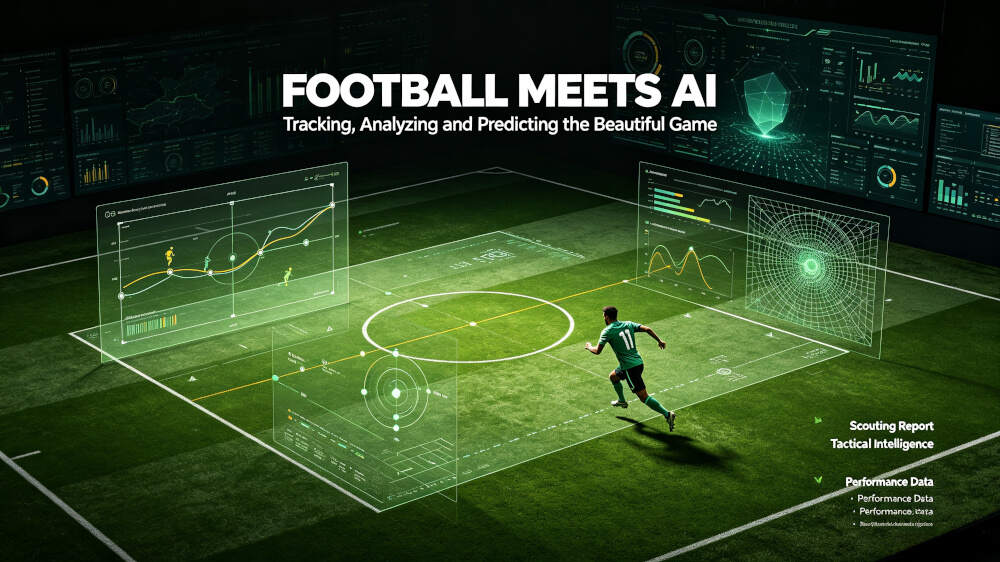
Artificial intelligence is changing football from the way clubs scout players to how coaches analyze matches, monitor performance, prepare tactics, and make recruitment decisions.
For decades, football decisions were driven primarily by a combination of human observation, coaching experience, statistics, and video analysis. Those methods remain important, but the amount of information available to modern football organizations has increased dramatically.
AI is helping clubs process that information faster and at a much larger scale.
Instead of relying only on analysts to manually review matches or scouts to watch individual players, football organizations can increasingly combine event data, tracking data, video, player statistics, and machine learning models to identify patterns that would be difficult to detect manually.
The result is a gradual shift from traditional football analytics toward a more intelligent, continuous, and data-assisted approach to decision-making.
What Does AI Mean in Football?
AI in football refers to the use of artificial intelligence and machine learning technologies to analyze football-related data, video, player movements, tactical patterns, and other information.
Depending on the application, AI can be used to:
- Analyze player performance
- Track player and ball movement
- Identify tactical patterns
- Support player scouting
- Compare potential recruits
- Analyze opposition teams
- Generate football metrics
- Assist coaching decisions
- Identify talent
- Monitor training performance
- Detect patterns related to physical performance
- Automate parts of football analysis
The important distinction is that AI does not simply mean "using statistics."
Traditional football analytics often focuses on describing what happened.
For example:
A midfielder completed 87% of his passes.
Football AI can go further by combining multiple sources of information to investigate why certain events happened and what patterns might be associated with them.
This is one of the most important changes AI is bringing to football.
From Football Analytics to Football Intelligence
Football analytics has existed for many years.
Clubs have used statistics such as goals, assists, shots, passes, tackles, possession, expected goals, and other metrics to evaluate players and matches.
AI adds another layer to this process.
Modern football systems can combine:
- Event data
- Player tracking
- Ball tracking
- Match video
- Positional data
- Physical performance data
- Historical statistics
- Scouting reports
- Tactical information
Machine learning models can then process these datasets to identify relationships, classify situations, generate predictions, or create new football metrics.
This creates a transition from:
Observation → Data Collection → Analysis → Decision
toward:
Observation + Data + Video + Tracking → AI-Assisted Analysis → Human Interpretation → Decision
The human element remains central.
The major change is that analysts, scouts, coaches, and recruitment teams can now work with much larger amounts of information than would be practical through manual analysis alone.
1. AI Is Changing Player Scouting
Player scouting has traditionally depended heavily on human observation.
Scouts watch matches, evaluate players, write reports, compare performances, and develop opinions about whether a player might fit a particular team.
AI can make this process more scalable.
Instead of starting with thousands of players and manually filtering them, recruitment teams can use data-driven systems to identify players who match specific characteristics.
For example, a club might search for a midfielder who:
- Progresses the ball frequently
- Operates effectively between the lines
- Recovers possession in advanced areas
- Has a particular physical profile
- Fits a specific tactical system
- Performs well against high-level opposition
- Matches the club's preferred age profile
AI can help identify candidates based on these criteria.
This does not eliminate scouting.
Instead, it can change where scouts spend their time.
Rather than manually searching the entire player market, scouts can focus more closely on a smaller group of relevant players.
2. AI Is Changing Player Performance Analysis
Modern football produces enormous amounts of performance data.
A player's performance can include information about:
- Passing
- Shooting
- Pressing
- Defensive actions
- Ball progression
- Positioning
- Running
- Acceleration
- Off-ball movement
- Decision-making
- Tactical behavior
AI can analyze these variables together rather than treating each statistic independently.
For example, a player's contribution may not be obvious from goals or assists alone.
A forward might create value through:
- Creating space
- Making decoy runs
- Pressing defenders
- Attacking specific areas
- Opening passing lanes
- Making movements that allow teammates to receive the ball
These behaviors can be difficult to quantify using traditional box-score statistics.
AI-powered tracking and video analysis can help football analysts study these off-ball behaviors at scale.
3. AI Is Changing Tactical Analysis
Tactical analysis is another area where AI can provide significant assistance.
Football tactics involve interactions between multiple players rather than isolated actions.
A tactical system can be represented through:
- Team shape
- Player positioning
- Passing networks
- Pressing structures
- Defensive lines
- Build-up patterns
- Space occupation
- Transition behavior
- Off-ball movement
AI can process these relationships across large numbers of situations.
For example, a system might analyze how a team responds when:
- The opponent builds from the goalkeeper
- A full-back moves into midfield
- A central midfielder receives between the lines
- Possession is lost
- The opponent attacks through a specific channel
Instead of examining every situation manually, analysts can use AI to identify recurring patterns and then investigate the most relevant examples.
This can make tactical preparation more efficient.
4. AI Is Changing Match Analysis
Traditional match analysis can require analysts to watch large amounts of video.
AI can automate parts of this workflow.
Computer vision systems can identify players, the ball, movement patterns, and specific events from match footage.
Tracking technology can then transform video into structured positional information.
This makes it possible to analyze questions such as:
- How high did a defensive line operate?
- How compact was a team?
- Which spaces did a team attack?
- How frequently did players make particular runs?
- How did the team's shape change during transitions?
- Where did pressing actions begin?
- How did players react after losing possession?
The value comes from connecting these observations with tactical context.
AI therefore has the potential to reduce the amount of manual work required to find relevant moments in a match.
5. AI Is Changing Football Recruitment
Recruitment decisions involve significant uncertainty.
A player may perform exceptionally well in one league but struggle after moving to another competition.
A recruitment team therefore needs to consider much more than raw statistics.
AI can help clubs compare players across different contexts by analyzing larger datasets.
Recruitment models can potentially consider factors such as:
- Age
- Position
- Playing style
- League strength
- Team tactics
- Performance trends
- Physical characteristics
- Technical actions
- Tactical behavior
- Historical development
The objective is not simply to find the player with the highest statistics.
The objective is to identify players whose characteristics may translate effectively into a particular football environment.
This is one reason AI is becoming increasingly relevant to modern recruitment departments.
6. AI Is Changing Talent Identification
Talent identification has traditionally required scouts to watch young players over long periods.
AI can help expand the number of players that can be evaluated.
A system can screen large datasets for unusual performance patterns or developmental characteristics.
For example, a club might use data to identify young players who demonstrate:
- Exceptional progression
- Strong physical development
- Unusual technical output
- Consistent performance
- Tactical adaptability
- Specific positional characteristics
The earlier a club can identify a promising player, the more opportunities it has to develop that player internally.
However, youth football is particularly difficult to evaluate using data alone.
Physical maturity, coaching environment, psychological development, and changes in playing position can all affect performance.
Human scouting therefore remains particularly important in talent identification.
7. AI Is Changing Football Training
AI is also becoming relevant outside matchday analysis.
Training environments can generate information about player workload, movement, technical actions, and physical performance.
AI systems can analyze this information to help coaches understand training patterns.
Potential applications include:
- Training-load monitoring
- Movement analysis
- Technical development
- Tactical drills
- Performance comparison
- Individualized training
- Recovery monitoring
For example, instead of giving every player identical training recommendations, clubs can increasingly use individual performance information to understand how different players respond to training.
This supports a more personalized approach to player development.
8. AI and Injury Prevention
Injury prevention is another area where large datasets can potentially provide useful insights.
Players generate information through matches and training, including:
- Running distance
- High-speed running
- Accelerations
- Decelerations
- Workload
- Recovery patterns
- Training exposure
AI models can analyze these variables together with historical information to identify unusual patterns or potential risk indicators.
The important point is that AI does not "predict injuries" with certainty.
Human medical and performance teams still need to interpret the information in context.
Instead, AI can function as another layer of monitoring that helps staff identify situations that deserve closer attention.
9. AI Is Changing the Role of Football Analysts
AI does not simply create new tools.
It can also change the role of the people using them.
A traditional analyst may spend significant amounts of time:
- Collecting data
- Tagging video
- Finding match clips
- Producing reports
- Preparing spreadsheets
- Repeating similar analysis
Automation can reduce some of these manual tasks.
This allows analysts to spend more time on:
- Interpreting results
- Asking better questions
- Connecting different datasets
- Understanding tactical context
- Communicating findings
- Supporting coaches
- Challenging assumptions
The analyst's value therefore increasingly comes from interpretation rather than simply collecting information.
The question becomes less:
"Can we find the data?"
and more:
"What does the data actually mean?"
10. AI Is Changing Football Decision-Making
Ultimately, the biggest impact of AI may not be a single technology.
It is the way AI can change the decision-making process.
A modern football decision can involve thousands or millions of data points.
AI can help reduce this complexity by identifying relevant information.
For example:
Scouting
Instead of manually reviewing thousands of players:
Large Player Pool → AI Filtering → Candidate List → Scout Evaluation
Match Analysis
Instead of manually searching an entire match:
Full Match Video → AI Detection → Relevant Situations → Analyst Review
Tactical Preparation
Instead of reviewing every opponent action:
Historical Matches → Pattern Detection → Tactical Insights → Coaching Preparation
Recruitment
Instead of comparing isolated statistics:
Player Data + Tracking + Context → AI Analysis → Recruitment Shortlist → Human Decision
AI therefore becomes part of a broader decision-support system.
Real-World Examples of AI in Football
The impact of football AI is not theoretical.
Professional clubs and football technology companies are already applying artificial intelligence to real football problems.
Liverpool FC and Google DeepMind
One of the best-known examples is the collaboration between Google DeepMind and Liverpool FC.
Google DeepMind developed TacticAI, an AI system designed to assist with football tactics, particularly corner-kick situations.
The system combines predictive and generative AI approaches to help analyze tactical scenarios and generate potential alternatives.
In evaluations involving Liverpool FC experts, TacticAI's suggestions were preferred over the original situations in a large majority of cases, demonstrating the potential for AI to act as a tactical assistant rather than simply a statistical reporting tool.
The project illustrates an important direction for football AI:
AI can generate football insights, not just describe football events.
Sevilla FC and IBM Scout Advisor
Sevilla FC has also explored generative AI for recruitment.
The club worked with IBM on Scout Advisor, a system designed to support scouting by allowing users to interact with football information using natural language.
The technology uses natural language processing and foundation models to search and analyze information contained within the club's scouting database.
This demonstrates how generative AI can change the interface between football professionals and large datasets.
Instead of manually searching through multiple reports and databases, users can interact with football information more naturally.
SkillCorner and AI-Powered Tracking
SkillCorner provides AI-powered tracking technology that can extract player and ball movement information from football video.
Its technology can track players and the ball from broadcast and tactical camera footage, creating detailed positional datasets.
This type of technology is particularly important because many football behaviors happen away from the ball.
Traditional event data might record a pass or shot.
Tracking data can help reveal:
- Where players were positioned
- How they moved
- How space was created
- How defensive structures changed
- How players behaved without possession
This creates a much richer representation of football performance.
Opta and AI-Enriched Football Data
Stats Perform's Opta ecosystem is another example of how AI is being integrated into football data.
Opta Vision combines event data with tracking information to produce more detailed football insights.
This allows analysts to study areas such as:
- Player movement
- Off-ball runs
- Tactical shape
- Pressure
- Space
- Passing
- Team structure
The broader trend is clear: football data is moving beyond simple event counts toward richer representations of player and team behavior.
What AI Still Cannot Do
Despite rapid development, AI has significant limitations in football.
Football is a highly contextual sport.
The same action can have completely different meanings depending on:
- Scoreline
- Opponent
- Match situation
- Tactical system
- Player instructions
- Competition
- Team quality
- Coaching philosophy
A model can identify a statistical pattern without fully understanding why that pattern occurred.
There are also factors that are difficult to quantify reliably.
These can include:
- Leadership
- Communication
- Personality
- Confidence
- Adaptability
- Dressing-room influence
- Response to pressure
- Relationship with teammates
- Ability to understand a coach's instructions
This is why AI should be treated as a decision-support technology rather than an autonomous football decision-maker.
The strongest systems combine machine intelligence with football expertise.
Will AI Replace Football Scouts and Coaches?
It is unlikely that football AI will simply eliminate the need for scouts and coaches.
Instead, their jobs are likely to evolve.
A scout may spend less time searching blindly through large player pools and more time evaluating whether a potential signing actually fits the club.
An analyst may spend less time manually tagging video and more time interpreting tactical patterns.
A coach may have access to more information before making a tactical decision.
In each case, AI can reduce repetitive work while increasing the amount of information available to football professionals.
The key advantage is not replacing football expertise.
It is giving that expertise better information.
What Will Football AI Look Like in the Future?
The next stage of football AI is likely to involve increasingly integrated systems.
Instead of separate tools for:
- Scouting
- Video analysis
- Tracking
- Performance
- Recruitment
- Tactical analysis
football organizations may increasingly connect these datasets.
Imagine a recruitment system that can combine:
Player Performance + Tracking Data + Tactical Context + Video + Historical Development + Team Requirements
A recruitment professional could then ask a question such as:
"Which under-23 midfielders in this competition have a similar playing profile to our current midfielder and could fit our pressing system?"
A more advanced system could then return:
- Relevant players
- Supporting statistics
- Tracking characteristics
- Tactical similarities
- Video examples
- Development trends
- Potential weaknesses
The human decision-maker would still evaluate the final recommendation.
But the amount of work required to reach that decision could be dramatically reduced.
The Future of Football Is Not Just More Data
One of the biggest misconceptions about football AI is that its purpose is simply to produce more statistics.
That is not the real opportunity.
Football already produces enormous amounts of data.
The challenge is making that information useful.
AI can help transform raw information into:
Data → Patterns → Insights → Decisions
This distinction is important.
A club does not gain a competitive advantage simply because it has more data.
It gains an advantage when it can interpret information faster, identify meaningful patterns, and turn those insights into better decisions.
That is where football AI becomes strategically important.
Final Thoughts
AI is changing football across scouting, recruitment, performance analysis, tactical preparation, match analysis, and player development.
The biggest transformation is not a single algorithm or software platform.
It is the transition from football analytics that primarily describes what happened toward football intelligence that helps people understand why it happened and what they might do next.
Real-world projects involving organizations such as Liverpool FC, Google DeepMind, Sevilla FC, IBM, SkillCorner, and Stats Perform show that this transition is already underway.
For football professionals, the future is likely to involve a closer relationship between human expertise and machine intelligence.
For fans, analysts, scouts, coaches, and clubs, understanding how these technologies work will become increasingly important as AI becomes part of the modern football ecosystem.
FAQ
How is AI changing football?
AI is changing football by helping clubs analyze player performance, scouting data, tactical patterns, match video, tracking data, recruitment information, and training performance at a much larger scale.
How is AI used in football scouting?
AI can analyze large player datasets and identify footballers who match specific performance, tactical, physical, age, or positional criteria. Scouts can then evaluate the most relevant candidates in greater detail.
How does AI help football coaches?
AI can help coaches analyze opponents, identify tactical patterns, study player performance, and review match situations more efficiently.
Can AI analyze football tactics?
Yes. AI can analyze player positioning, team shape, movement patterns, pressing structures, passing relationships, and other tactical information.
Can AI replace football scouts?
AI is more likely to support than completely replace football scouts. Scouts still provide contextual judgment about factors that are difficult to capture through data alone.
How is AI used in football recruitment?
AI can help recruitment teams filter large player pools, compare players, identify similar profiles, analyze performance trends, and support decisions about potential transfers.
What is football tracking data?
Football tracking data records the positions and movements of players and, in some systems, the ball throughout a match. It can reveal information about positioning, movement, spacing, and tactical behavior that traditional event data cannot fully capture.
What is the difference between football analytics and football AI?
Football analytics traditionally focuses on collecting and analyzing football data. Football AI adds machine learning, computer vision, generative AI, and automated pattern recognition to process more complex datasets and support more advanced analysis.
Will AI become more important in football?
Yes. As clubs collect more video, tracking, performance, and event data, AI is likely to become increasingly important for turning this information into useful football insights.
Explore more football AI topics on AICUP.tools.
Discover how artificial intelligence, data, analytics, and automation are transforming modern football.
Related AI Tools

Sofa Score
Sofascore is a global live sports scores and analytics platform that provides real-time football scores, fixtures, statistics, player ratings, match visualizations, league tables, and performance analysis for more than 500 football leagues and thousands of sports competitions worldwide.

BetMines Football Betting Tips
BetMines is an AI-powered football betting analysis and prediction app used by over 4 million users. It provides daily AI-generated football betting tips, match predictions, live and pre-match scanners, team statistics, odds analysis, livescores, and social betting features across more than 150 football leagues worldwide.

Olocip
Olocip is an AI-powered football analytics and scouting platform that uses advanced artificial intelligence to provide predictive and prescriptive insights for professional football organizations. The platform helps clubs improve recruitment, player valuation, performance analysis, injury prevention, and strategic decision-making by transforming football data into actionable intelligence.

NerdyTips
NerdyTips is an AI-powered football prediction and betting analytics platform that uses artificial intelligence, machine learning, mathematical modeling, and proprietary algorithms to analyze football matches across 160+ leagues worldwide. It provides AI-generated betting tips, match predictions, correct score analysis, statistics, odds analysis, and data-driven insights to help users make more informed football betting decisions.