
What Is Football AI? How Artificial Intelligence Is Changing Football
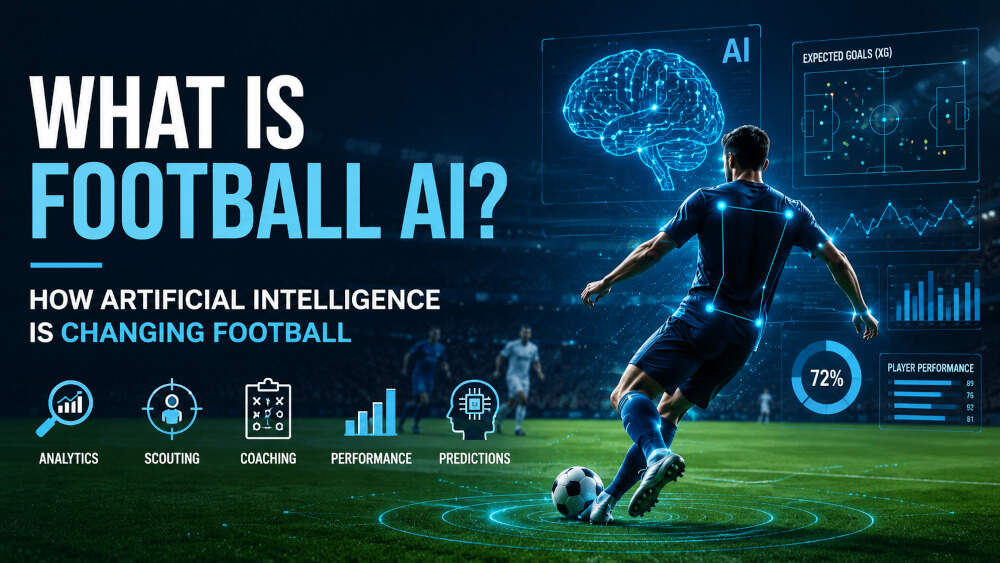
Modern tracking systems collect millions of data points per single match: player and ball coordinates, speed, accelerations, events, and much more. No analyst could realistically process all of that manually..
Football AI is the use of artificial intelligence to turn that chaos into decisions — who to sign, how to press, who is fatigued, and where the opponent is vulnerable.
AI doesn’t replace the coach. It answers “What is actually happening?” while the coach decides “What should we do about it?”
The best modern setup looks like this: data → AI analysis → expert interpretation → decision.
How Does Football AI Work? 3 Core Technologies
1. Machine Learning: Finding Hidden Patterns
A model learns from tens of thousands of matches to find what the eye can’t. Two midfielders can both have 90% pass accuracy, but the model sees that one only passes backwards under zero pressure, while the other plays progressive passes that actually move the attack forward.
It looks at metrics like progressive passes and progressive carries (passes and runs that move the ball significantly towards goal), xT (expected threat), pressures, and counter-pressing recoveries.
2. Computer Vision: Turning Video Into Data
Computer vision is one of the technologies that makes large-scale video analysis possible. Computer vision systems turn regular video footage into structured data — detecting player and ball positions, team shape, and free space.
Video stops being just video. It becomes a spreadsheet. This allows for automatic creation of highlights, pitch control maps (which team controls which zones), and pressing reports.
3. Predictive Models
Models use historical and current data to estimate probabilities, not to predict the future. For example: expected goals (xG), expected points (xPoints), or changes in team form.
Important: an AI prediction is not a guarantee. It reduces uncertainty, but football will always remain highly unpredictable.
How Is AI Used in Football? Real Applications
1. Scouting & Recruitment: How Clubs Like Brighton Compete With Giants
Classic scouting no longer works alone. If a club is looking for a midfielder under 23 who plays well under pressure, a scout would have to watch hundreds of candidates manually.
AI works differently:
First, filtering by profile: age, position, league, minutes played, physical data. From tens of thousands of players in databases like StatsBomb, you get a shortlist.
Then, style comparison. Two players can have identical passing stats but behave completely differently under pressure. For a club with a specific playing style, this is the key difference.
AI is the filter. The scout is the decision-maker. AI narrows the list from 1000 to 10. A human makes the final call.
Learn more in our football analysis and scouting topic.
2. Tactical Analysis & Match Analysis
After a game, the system can quickly show where the team lost possession, how the press worked, which zones were used most, and which combinations created chances.
For opponent preparation, AI helps identify recurring patterns: which flank the opponent uses for most attacks, how its shape changes after losing the ball, or how its pressing intensity (PPDA — passes allowed per defensive action) drops after 60 minutes.
3. Training & Player Performance
Data from GPS trackers and training sessions helps personalize workload. The coaching staff can better understand who needs rest, who needs extra sprint work, and which tactical elements need attention.
For players, AI tracks not just goals and assists but dynamics: is he progressing the ball more, recovering faster into defence, or becoming more effective in pressing?
Explore our sections on football coaching and training and performance analysis.
Real-World Examples: Who Actually Uses Football AI?
Football AI is no longer an experiment — it’s part of the daily routine for top clubs:
- Data-driven clubs like Brighton & Hove Albion and Brentford are well known for their analytics-first approach. They use data to find players in less-scouted markets, with Moisés Caicedo — signed by Brighton from Independiente del Valle in 2021 — being one of the most cited examples.
- Tracking providers: Second Spectrum is the official tracking provider for the Premier League, while companies like SkillCorner provide tracking data from broadcast video for clubs and leagues worldwide.
- Load management: Clubs use platforms like Zone7 to analyze training data, load history and other indicators to flag players at increased risk of overload.
- Tech partnerships: Projects like Sevilla FC’s collaboration with IBM Watson for scouting support show how clubs are experimenting with generative AI to process scouting reports.
What Are the Different Types of Football AI Tools? [Directory]
In our directory at AICUP.tools we have collected and systematized 50+ AI tools for football into 4 categories:
1. AI for Video & Tracking Turns video into data. Examples: Veo, Hudl.
2. AI for Scouting & Recruitment Finds players by profile and models their fit. Examples: StatsBomb IQ, TransferLab.
3. AI for Performance & Health Tracks physical data and helps manage load and injury risk.
4. AI for Predictions Analyzes historical data to estimate outcome probabilities.
Football AI vs Traditional Analysis
| Traditional Analysis | Football AI Analysis |
|---|---|
| Relies on human experience and observation | Relies on large volumes of objective data |
| Requires hours of manual clipping | Automated clipping in minutes |
| Excellent at understanding context — why it happened | Excellent at finding patterns — where and how often it happens |
| Limited to 5-10 games per week per analyst | Can compare thousands of players and matches at once |
The strongest organizations combine both.
What Are the Limitations of Football AI?
1. Data Quality. Incomplete or inconsistent data leads to unreliable results. A model trained on Premier League data will not work well in an amateur league without proper data.
2. Context. Stats don’t explain the reason. A low passing percentage might be due to a coach’s instruction to play only risky forward passes, not poor technique. AI doesn’t know that without a human.
3. The Human Factor. Team chemistry, mentality, adaptability, and pressure of a penalty shootout cannot be fully quantified. That’s why AI is a co-pilot, not an autopilot.
What Is the Future? Generative AI
The next step is moving from dashboards to dialogue.
Instead of checking ten different reports, a coach will be able to ask the system in natural language:
“Why did we struggle to progress the ball against a high press in the last five games?”
And generative AI will combine video, tracking and event data to return a structured answer with clips and diagrams in 30 seconds.
At AICup.tools, we are already testing such AI agents to make football analytics accessible not only to data departments but also to coaches and scouts.
FAQ
What does Football AI mean?
Applying artificial intelligence technologies like machine learning and computer vision to football data, video, players and tactics to support decision-making.
How is AI used in football scouting?
It analyzes stats of thousands of players to find those matching a specific profile and drastically shortens the initial longlist for human scouts.
Can AI predict football matches?
AI models can calculate probabilities of different outcomes based on data, but they can never guarantee a result because football has high inherent uncertainty.
Will AI replace football scouts and coaches?
No. AI provides more data and context, but tactical, managerial and recruitment decisions still require human expertise, leadership and judgment.
Is Football AI only for professional clubs?
No. Cloud-based tools like Veo for video analysis and Hudl for amateur teams have made advanced analytics accessible to academies, coaches and even fans.
Conclusion
The main value of AI is not to replace football experts. AI gives people more data, more context and more time for analysis.
The future belongs to the combination of data, artificial intelligence and human expertise.
Ready to explore? Check our directory of football AI tools on AICUP.tools — we have collected and systematized 50+ solutions for scouting, analysis, coaching and performance.
Related AI Tools

180Score
180Score is an AI-powered football analytics and prediction platform that combines live scores, match statistics, historical data, team performance, fixtures, standings, and machine-learning-based insights. It provides pre-match predictions and analytical indicators across markets such as 1X2, double chance, both teams to score (BTTS), and over/under goals, while also offering live match updates, team statistics, competitions, news, notifications, and personalized favorites.

BetMines Football Betting Tips
BetMines is an AI-powered football betting analysis and prediction app used by over 4 million users. It provides daily AI-generated football betting tips, match predictions, live and pre-match scanners, team statistics, odds analysis, livescores, and social betting features across more than 150 football leagues worldwide.


CatchThat
CatchThat is an AI-powered sports software studio that creates fan-focused sports products, including AI-generated sports newsletters, roster management tools, simulations, and interactive games for NFL, MLB, NBA, and NHL fans. The platform combines sports data, AI technology, and lightweight fan experiences to help users stay informed and engage more deeply with professional sports.