
Brazil Edge Japan in Dramatic Finish as Age Concerns Loom Ahead of Knockouts
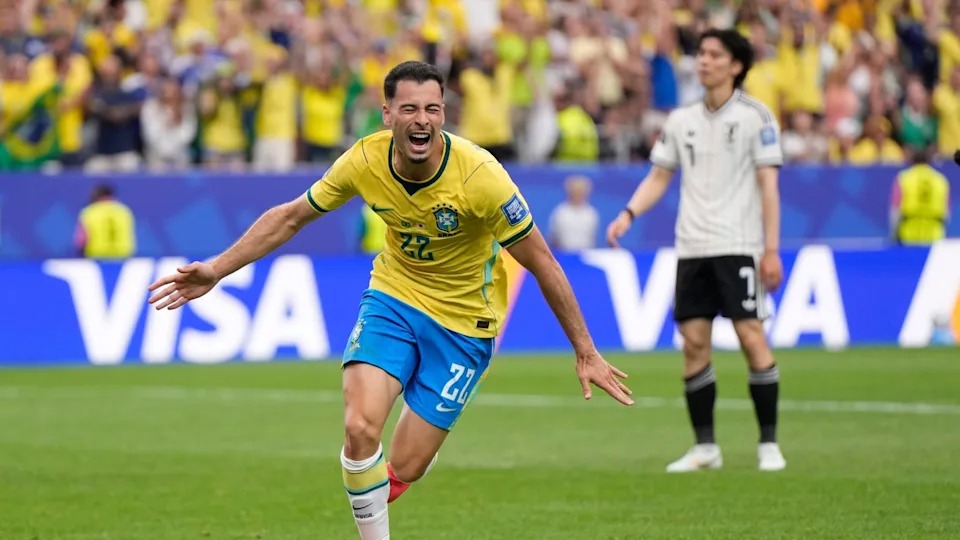
HOUSTON — Gabriel Martinelli struck five minutes into stoppage time to secure a 2-1 victory for Brazil against Japan. The five-time World Cup winners had to fight back after Kaishu Sano’s first-half goal left them staring at a potential upset.
Sano’s 29th-minute strike stunned Carlo Ancelotti’s side and briefly raised the possibility of Brazil suffering a first-ever competitive loss to Asian opposition — which would have ranked among the tournament’s biggest shocks. But Casemiro powered home a header in the 56th minute to level the score, sparking a second-half onslaught as Brazil pushed hard for a winner.
Japan defended resolutely, with goalkeeper Zion Suzuki pulling off several vital saves to keep his team in the game. However, Brazil snatched victory in the dying seconds when Arsenal forward Martinelli finished from close range after being played in by Bruno Guimarães.
Brazil will now face the winner of Norway versus Ivory Coast in the round of 16 on Sunday in New Jersey.
Ageing Brazil Side Avoids Upset — But Are They Too Old to Win the World Cup?
Casemiro’s midfield dominance and crucial equaliser once again showed just how vital the former Manchester United star remains to Ancelotti’s team. Yet there’s no hiding the fact that, at 34, he is part of a squad filled with players in their 30s.
With an average age of 29 years and 245 days, this was Brazil’s second-oldest World Cup squad since 1966, behind only the team that faced France in the 2006 quarterfinals.
Starters like Casemiro, Alisson Becker (33), Danilo (34), Marquinhos (32), and Douglas Santos (32) all featured, and their lack of pace and mobility was glaringly obvious as Japan’s energetic movement caused problems in the first half.
Ancelotti will point to his team’s experience as the reason they stayed in the match and eventually won it. Still, the lack of emerging young talent in Brazil is evident — and it’s precisely why this squad ranks among the oldest at the tournament.
When the pressure ramps up in the knockout stages — possibly against Norway next — this experienced but ageing side may struggle to go all the way.
A Frustrating Night for Vinícius Júnior
This match perfectly captured both the brilliance and the frustrations surrounding Vinícius Júnior. The Real Madrid star is one of the most dynamic attackers in club football, but he has yet to replicate that same level of impact for his country.
With just 13 goals in 53 appearances for Brazil, his international record lags well behind the likes of Kylian Mbappé, Harry Kane, or Erling Haaland for their national teams.
The 25-year-old nearly produced a moment of magic in the second half with a dazzling run that ended in a shot tipped onto the post by Suzuki. It would have been one of the greatest World Cup goals ever seen. Instead, Japan’s keeper stood tall.
After that highlight, however, Vinícius slipped back into his more disappointing international form. For a player with Ballon d’Or ambitions, delivering on the biggest stage when it matters most is essential — and against Japan, he came up short.
Casemiro Delivers Again on the Big Stage
Casemiro enjoyed a strong season at Manchester United last year, scoring eight headed goals for the Premier League side — many of them in crucial moments. He once again proved his worth in big games by heading Brazil back into this contest early in the second half.
It was a trademark Casemiro goal: powerful, decisive, and perfectly timed from a cross into the box. That strike brought his international tally to five headed goals out of ten for Brazil.
Despite his age and recent injury issues, Casemiro retains a remarkable ability to influence matches. This is exactly why Inter Miami are reportedly close to signing him for MLS.
Unfortunately, he limped off late in the game with what appeared to be a groin injury. If he misses the round of 16, it would be a significant blow for Ancelotti.
Japan’s Persistent Knockout Stage Struggle Continues
This was Japan’s fifth straight failure to advance past the first knockout round. Despite impressive group-stage wins in past tournaments — including memorable victories over Germany and Spain in 2022 — the Samurai Blue continue to fall short when it matters most.
Monday’s defeat felt like a major missed opportunity. Japan more than matched Brazil in the first half and even led at the break, only to collapse after halftime.
Veteran Yuto Nagatomo once famously called this barrier “the wall of the last 16.” With the tournament expanded, it’s now the wall of the last 32 — and Japan still haven’t found a way through it.
Moriyasu’s Tactical Masterclass Falls Short
For the opening 45 minutes, Japan coach Hajime Moriyasu looked like a tactical genius. While Brazil controlled possession, their attackers — Vinícius Júnior, Matheus Cunha, and young Rayan — were largely kept quiet.
Japan’s disciplined five-man defensive block, supported by wingbacks tucking inside and a high-pressing front line led by Daizen Maeda, Junya Ito, and Ayase Ueda, frustrated Brazil effectively. Sano’s goal came from winning the ball in midfield and surging forward.
However, Japan sat deeper after the break, allowing Brazil to equalize and eventually take control. Moriyasu’s later defensive substitutions showed a shift toward caution — a surprising choice for a team that had boldly declared its World Cup ambitions.
A Disappointing Tournament for Asia Overall?
The Asian Football Confederation (AFC) started strongly, remaining unbeaten in their first six matches. Since then, results have sharply declined.
Australia, who face Egypt on Friday, remain the continent’s last hope. Japan and Australia can reasonably claim they did okay by reaching the round of 32, but there was genuine belief they could go further.
Other campaigns were far more disappointing. South Korea’s group-stage exit led to coach Hong Myung-bo’s resignation and calls for a major overhaul of the national federation. Saudi Arabia and Qatar also underperformed after promising starts, while Iraq’s return after 40 years ended with a heavy goal difference.
On the brighter side, Iran earned praise as one of the unluckiest teams, remaining unbeaten with solid draws. Debutants Uzbekistan and Jordan gained valuable experience and scored memorable goals.
Nevertheless, regardless of how far Australia advance, this World Cup will likely be remembered as a disappointment for Asian football. The continent now faces another four-year wait to make a stronger impression.