
How AI Is Used in Football Scouting
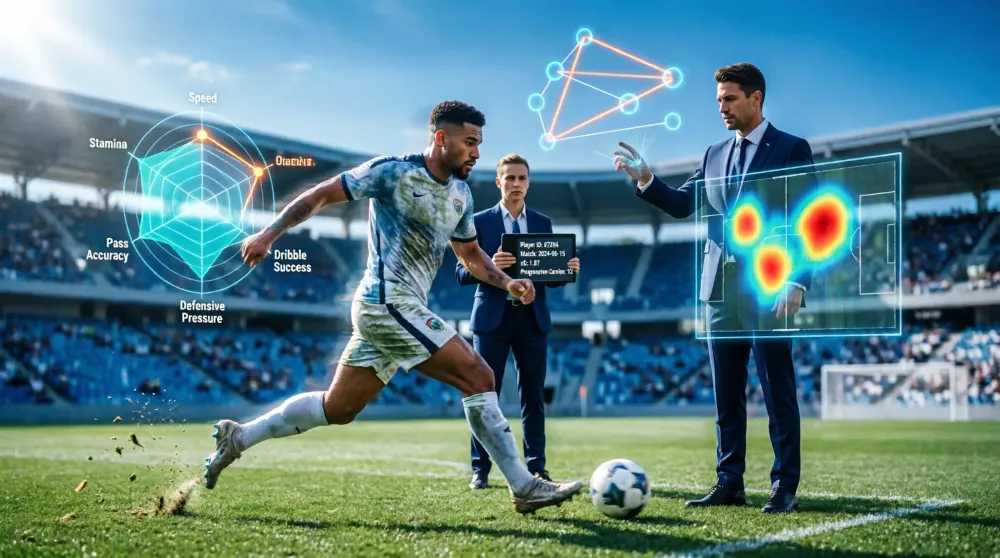
Artificial intelligence (AI) is used in football scouting to help clubs identify potential recruits, compare players, analyse performance data and prioritise candidates for further assessment. By processing large datasets, AI systems can highlight players who match a club's tactical requirements, recruitment criteria or development objectives.
AI does not replace the work of scouts. Its value lies in helping recruitment departments narrow large player pools, organise evidence and identify candidates who might otherwise receive less attention. Scouts and analysts still need to assess technical ability, tactical understanding, decision-making, adaptability and suitability for a particular team.
The practical role of AI depends on the quality of the available data, the recruitment question being asked and how the club combines analytical findings with live observation. Understanding these factors is essential to evaluating what AI can contribute to modern football scouting.
What Is AI Football Scouting?
AI football scouting is the application of artificial intelligence techniques to player identification, evaluation and recruitment-related analysis. These systems use data to identify patterns, estimate particular outcomes or rank players against defined criteria.
Traditional scouting combines live observation, video analysis, background information and professional judgement. Data-led scouting adds structured evidence from match events, player tracking, physical testing and career histories. AI can extend this process by analysing relationships across multiple variables and screening players at a scale that would be difficult to manage manually.
It is important to distinguish AI scouting from football analytics more broadly. Football analytics covers a wide range of questions about matches, teams and players, while scouting applies relevant information to identifying and evaluating potential recruits. AI is one possible method within that process, rather than a synonym for either analytics or scouting.
For a wider introduction, see How AI Is Used in Football: Analytics, Scouting, Tactics and More.
How AI Works in Football Scouting
An AI-supported scouting workflow typically moves from defining a recruitment need to collecting relevant data, screening candidates and validating the resulting shortlist. The precise process varies between clubs and technology providers, but several stages are common.
1. Define the recruitment profile
The process starts with a footballing requirement. A club might need a centre-back who is comfortable defending space behind a high defensive line, a midfielder who progresses possession under pressure or a forward who creates chances through movement without the ball.
The recruitment department translates that requirement into criteria that can be assessed. These might include age range, preferred position, playing style, competition level, technical indicators and physical characteristics.
This step matters because an AI system cannot determine the right signing without a clearly defined objective. A model designed to identify high-performing players in one role may be unsuitable for finding a different type of player or assessing whether someone fits a particular tactical system.
2. Collect and prepare player data
AI systems rely on input data. Depending on the platform and recruitment question, this may include:
- Event data: recorded actions such as passes, shots, tackles, interceptions and ball recoveries.
- Tracking data: player and ball positions over time, where this information is available.
- Physical and testing data: measurements such as sprint speed, acceleration or results from structured assessments.
- Player profiles: age, position, height, club history, competition level and other relevant background information.
- Video and scouting observations: match footage, coded actions and structured assessments, where supported by the system.
These sources offer different perspectives. Event data can describe what a player does on the ball, while tracking data can provide information about movement, spacing and off-ball behaviour. Neither automatically explains every tactical decision or the circumstances in which an action occurred.
Data preparation is equally important. Definitions may differ between providers and competitions, while missing observations and inconsistent coverage can affect comparisons. Before using the data, analysts need to understand what is available, how it was collected and whether the variables are suitable for the question being investigated.
3. Screen and rank potential recruits
Once a recruitment profile and suitable dataset are available, analytical systems can filter candidates and compare their attributes. Machine learning may identify combinations of indicators associated with a particular playing role or outcome.
For example, a club looking for a progressive midfielder might screen for passing involvement, forward ball progression, ball retention and relevant defensive contributions. The exact measures should reflect the club's playing model and the context in which the player operates.
A ranking system can help prioritise candidates for further review. However, a high ranking is not proof that a player is the best available signing. The result depends on the selected variables, comparison group, data coverage and model design.
4. Review candidates through video and live scouting
The next stage is to investigate why a player has been flagged. Scouts and analysts can review match footage, examine individual actions and assess whether statistical patterns are consistent with what they see on the pitch.
Video is particularly useful for understanding context. A successful pass may reflect excellent awareness, but it may also be a simple option in a low-pressure situation. A player with a high number of defensive actions may be effective at winning the ball, or may be playing in a team that spends long periods defending.
AI-generated findings should therefore guide further investigation rather than replace it. Live observation remains important when a club needs to assess communication, movement away from the ball, response to pressure and behaviour that is difficult to capture reliably in structured datasets.
5. Build and maintain a recruitment shortlist
After analytical screening and scouting review, recruitment staff can organise candidates according to their suitability, evidence gaps and priority for further assessment.
A shortlist may include players who appear to fit the immediate requirement, alternatives who offer a different profile and younger candidates who could be relevant to a longer-term development plan.
AI can help update this process when new data becomes available, but the club still needs to decide how much weight to give each candidate, what further evidence is required and whether the player is realistically recruitable.
Key Applications of AI in Football Scouting
AI can support several distinct parts of player recruitment. Its usefulness depends on matching the method to the decision being made.
Player identification across competitions
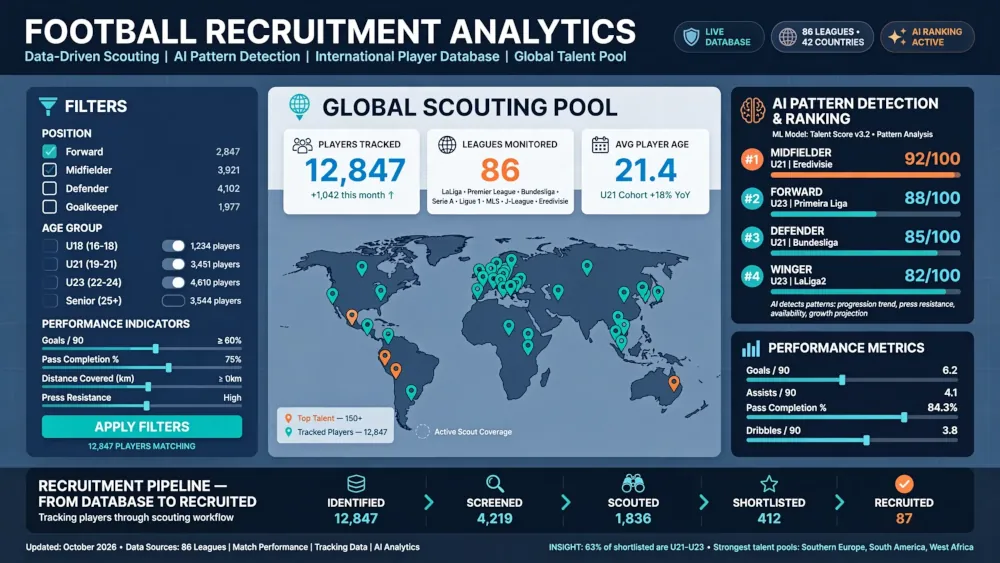
Recruitment departments may need to review players across multiple leagues, age groups and competitive environments. Manually monitoring every relevant player is difficult, particularly when the potential recruitment pool is international.
Data platforms can filter large player databases by position, age, performance indicators and other criteria. AI can add pattern detection or ranking to this screening process, helping staff identify candidates for closer examination.
Coverage is an important consideration. A player may appear absent from a shortlist because the relevant competition is not covered, data is incomplete or the player's role is poorly represented by the selected metrics. A system's search results should not be treated as a complete picture of the available talent.
Comparing players with similar roles
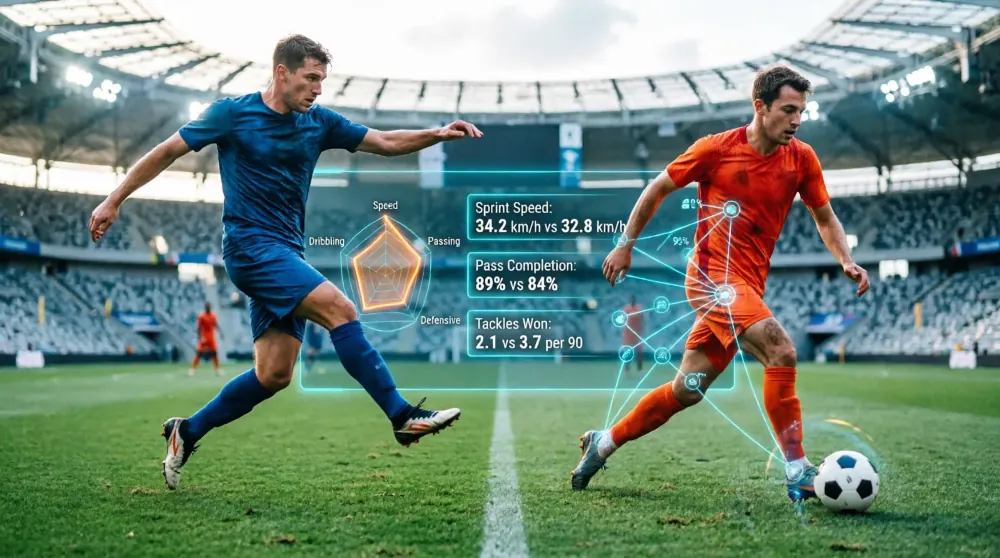
Player comparison is more useful when candidates are evaluated against others with comparable responsibilities. A full-back operating in a possession-dominant side may have different passing and defensive opportunities from one playing in a deep defensive block.
AI-supported comparison can combine multiple indicators to highlight similarities and differences between players. Analysts should account for position, tactical role, team style, competition level and playing time before interpreting the results.
This is one reason that simple rankings across an entire league can be misleading. The most productive player statistically is not necessarily the best fit for a specific recruitment brief.
Assessing playing style and tactical suitability
Recruitment is not only about identifying the strongest individual performer. Clubs also need players whose attributes complement the team's tactical approach.
Depending on the available data, analytical models may help describe aspects of a player's style, such as involvement in build-up play, ball progression, defensive activity or attacking movement. Tracking data can add information about positioning and movement that event data alone may not capture.
These indicators can inform questions about tactical suitability, but they cannot settle them in isolation. A club must consider the player's decisions, role-specific responsibilities and ability to adapt to a different coaching environment.
For more detail on how data is interpreted in match contexts, see How AI Helps Analyse Football Matches.
Identifying emerging talent
AI can help academies and recruitment departments monitor players who may warrant additional attention. Depending on the data available, models may combine match indicators, physical assessments, development history and other relevant information to identify patterns associated with progression.
Youth scouting requires particular caution. Players mature at different rates, and physical development can affect short-term performance. A model trained on players who are already successful may favour those who develop earlier or resemble the players represented in its training data.
A young player with modest current statistics may still have considerable room to develop. Longitudinal evidence, repeated observation and an understanding of individual development are therefore essential when using AI to support talent identification.
AI-based potential assessments should be treated as uncertain estimates, not fixed predictions of a player's future level.
Supporting transfer and squad planning
Recruitment decisions also depend on the existing squad. A player may be attractive in isolation but unnecessary for a team that already has several players with similar strengths and limitations.
AI-supported recruitment systems can help compare candidates against squad profiles and identify areas where additional capabilities may be useful. Depending on the available information, clubs may also consider age profile, expected development, contract circumstances and the practical conditions of a potential transfer.
These applications support the wider recruitment process rather than replacing it. A data model cannot establish every relevant factor, such as a player's willingness to move, personal circumstances or the final terms of a negotiation.
What Data and Metrics Matter in AI Scouting?
There is no universal set of metrics that identifies the right player for every club. Useful indicators depend on the role, playing model, competition and decision under consideration.
| Data type | What it can help assess | Important limitation |
|---|---|---|
| Event data | Passing, shooting, ball progression and defensive actions | Does not always explain the context or difficulty of an action |
| Tracking data | Positioning, movement, spacing and off-ball behaviour | Availability, collection methods and definitions may vary |
| Physical testing | Specific physical capacities measured under defined conditions | Test results may not translate directly into match performance |
| Player and career profiles | Age, position, competition history and background | Profiles can be incomplete or outdated |
| Video and scouting reports | Technique, decisions, tactical behaviour and contextual detail | Assessments require consistent methods and qualified interpretation |
| Longitudinal data | Changes in performance and development over time | Requires comparable observations across relevant periods |
Metrics such as expected goals (xG), progressive passing and defensive actions can contribute to player evaluation when they are appropriate to the role being assessed. Their meaning depends on definitions and context.
For example, xG estimates the likelihood that a shot will result in a goal based on characteristics of the chance. It can help describe shooting opportunities, but it does not independently measure every aspect of a forward's movement, link-up play or tactical contribution.
Likewise, the number of progressive passes does not reveal the full value of a midfielder's performance. Analysts may need to consider the pressure on the passer, the availability of teammates, the risk of the pass and the team's tactical objectives.
AI can combine different indicators, but combining more variables does not automatically produce a better evaluation. The data must be reliable, relevant and interpreted in relation to the recruitment question.
AI Scouting Tools and Platforms
Football recruitment platforms can help scouts search player databases, compare profiles and create shortlists. Some systems provide advanced metrics and player assessments, while others focus on data access, video workflows or integration with a club's internal processes.
The SciSports scouting platform is one example of a product positioned around data-driven player search, comparison and recruitment insights. Its published description covers player databases, filtering, advanced metrics and player shortlisting.
Other resources in the AICUP.tools directory serve related but different purposes. Comparisonator and DataMB are relevant starting points for exploring player comparison and football data analysis. Their suitability for a particular recruitment workflow depends on current functionality, data coverage and the club's requirements.
When evaluating a scouting platform, recruitment departments should consider:
- Competition coverage: Are the leagues and player groups relevant to the club included?
- Data definitions: Are metrics explained clearly enough to support fair comparisons?
- Role-specific analysis: Can candidates be assessed against the responsibilities of the target position?
- Video and observation workflows: Can analysts investigate why a player has been flagged?
- Transparency: Can staff understand the basis of a score, ranking or recommendation?
- Integration: Can the system work with existing scouting databases and recruitment processes?
- Cost and resources: Does the value justify the subscription, implementation and staff time required?
A platform marketed as AI-powered is not necessarily the best option for every club. Recruitment teams should assess whether the available functions solve a real problem and whether the outputs can be validated in practice.
Benefits of AI in Football Scouting
When applied appropriately, AI can offer several practical advantages.
More efficient initial screening
Automated filtering can reduce the time spent manually reviewing large player pools. Scouts can focus their attention on candidates who meet the initial criteria, although the quality of that shortlist depends on the underlying data and screening rules.
More consistent comparisons
Structured metrics can help recruitment staff compare candidates using common criteria. This can make assumptions more visible and encourage a more systematic discussion between scouts, analysts and coaches.
Consistency does not guarantee objectivity. The choice of metrics, comparison groups and model design can all influence the results.
Wider recruitment coverage
Data-led screening can help clubs explore competitions and player groups beyond those they monitor most closely. This may reveal candidates who deserve further investigation, provided the data coverage is sufficient.
Better integration of evidence
AI outputs can bring together several sources of information and help staff organise their findings. When combined with video, live scouting and tactical assessment, these insights can contribute to a more structured recruitment decision.
Limitations and Risks of AI Football Scouting
AI scouting is only as useful as the evidence and decisions built around it. Several limitations need to be considered before its outputs influence recruitment.
Data quality and coverage
Missing matches, inconsistent event definitions and differences in data collection can distort comparisons. If one competition has detailed tracking data while another has only basic event statistics, candidates may not be assessed on an equivalent basis.
Recruitment staff should understand where the data comes from, what it covers and which players or competitions are under-represented.
Tactical and competitive context
Players operate within different systems and levels of competition. Their statistics can reflect team style, teammates' abilities, opposition quality and the responsibilities assigned by the coach.
A model may identify a pattern accurately within its dataset without proving that the same pattern will hold in another league or tactical environment. Cross-competition comparisons require careful interpretation and, where possible, additional validation.
Bias in player identification
AI systems can reproduce biases in historical data. If previous recruitment decisions favoured particular physical profiles, competitions or development pathways, a model trained on those decisions may reinforce the same preferences.
This can be especially problematic in youth scouting, where relative age and differences in biological maturation can influence observed performance. Clubs should examine who is represented in their data, which outcomes the model learns to predict and whether the results systematically exclude relevant candidates.
Uncertainty in predicting future potential
Current performance and future development are different questions. A model may identify players who currently match a successful profile without reliably predicting who will improve most over the next several seasons.
Longitudinal evidence and external validation are important, but they do not eliminate uncertainty. Development depends on multiple factors, including coaching, opportunity, health, adaptation and changes in competitive environment.
Limited explainability
Some models produce rankings or scores without making the reasoning easy to interpret. If scouts cannot understand why a player has been recommended, they may struggle to assess whether the result reflects a meaningful footballing quality or an artefact of the data.
Explainable outputs and transparent evaluation criteria can make it easier for recruitment staff to challenge, verify and use model recommendations appropriately.
Privacy and governance
Player data must be handled responsibly, particularly when it concerns young players or includes sensitive personal information. Clubs should establish appropriate access controls, data retention practices and governance procedures, and ensure that their use of data complies with applicable requirements.
AI scouting should operate within a clear framework of accountability. Decisions about recruitment and player development remain the responsibility of the people and organisations making them.
Does AI Replace Football Scouts?
No. AI can support parts of the scouting process, but it does not remove the need for skilled scouts, analysts and recruitment decision-makers.
Data-driven methods are particularly useful for screening large candidate pools, comparing structured indicators and identifying players for further review. Human observation remains important for interpreting technical execution, tactical understanding, decision-making, communication and behaviour in context.
The most effective approach is complementary. Data can direct attention towards a player, video can help explain the observed patterns, and live scouting can test whether the player's qualities translate into the situations that matter to the recruiting club.
Scouts also contribute knowledge that may be difficult to encode in a model. They understand the recruitment brief, recognise contextual details and can investigate questions that emerge during observation. AI can help organise the evidence, but it cannot make every judgement required for a successful signing.
The Future of AI in Football Scouting
Further progress in AI scouting will depend not only on more sophisticated algorithms, but also on better data, more transparent methods and stronger evaluation in real recruitment environments.
More comprehensive tracking data and improvements in video analysis may help analysts examine off-ball behaviour and tactical context in greater detail. Longitudinal datasets may also support more careful study of player development, provided the information is collected consistently and models are tested beyond the samples used to develop them.
However, technical advances alone will not resolve every challenge. Clubs still need to determine whether a model answers a meaningful recruitment question, whether its outputs generalise to the relevant competition and whether the results improve the quality of decisions.
The priority should be practical reliability rather than complexity for its own sake. AI is most useful when it provides interpretable evidence that scouts and recruitment departments can test, challenge and incorporate into their existing processes.
Conclusion
AI is used in football scouting to screen player populations, compare candidates, identify potential recruits and organise evidence for recruitment decisions. By analysing structured data at scale, it can help clubs focus their attention and explore candidates across different roles and competitions.
Its contribution nevertheless depends on the quality of the data, the relevance of the recruitment profile and the ability to interpret findings in tactical and developmental context. Statistical rankings cannot fully capture a player's suitability for a club or guarantee future success.
AI should therefore be treated as a decision-support capability within a wider scouting process. Combining data analysis with video review, live observation and professional judgement offers a more defensible basis for evaluating players than relying on model outputs alone.
Frequently Asked Questions
How is AI used in football scouting?
AI can help identify potential recruits, screen player databases, compare performance indicators, assess playing styles and prioritise candidates for further scouting. Its outputs support the recruitment process rather than determine the final decision.
Can AI predict a football player's future potential?
AI models can estimate particular outcomes using historical data, but predicting long-term development is difficult. Results depend on the quality and representativeness of the data, the outcome being predicted and whether the model has been validated in relevant settings.
What data does AI use for player scouting?
Depending on the system, it may use match event data, tracking data, physical assessments, player profiles, career history and structured scouting observations. The available sources and their quality vary between providers and competitions.
Is AI scouting suitable for youth football?
AI can help academies organise information and identify players for further assessment. However, youth development is affected by maturation, relative age, coaching and opportunity, so model outputs should be interpreted cautiously and should not be treated as definitive judgements of a young player's potential.
Does AI make football recruitment more objective?
AI can make comparisons more systematic, but it does not automatically remove bias. Historical data, metric selection, incomplete coverage and model design can all influence outcomes. Human review and transparent evaluation remain essential.