
How AI Tracks Football Player Performance
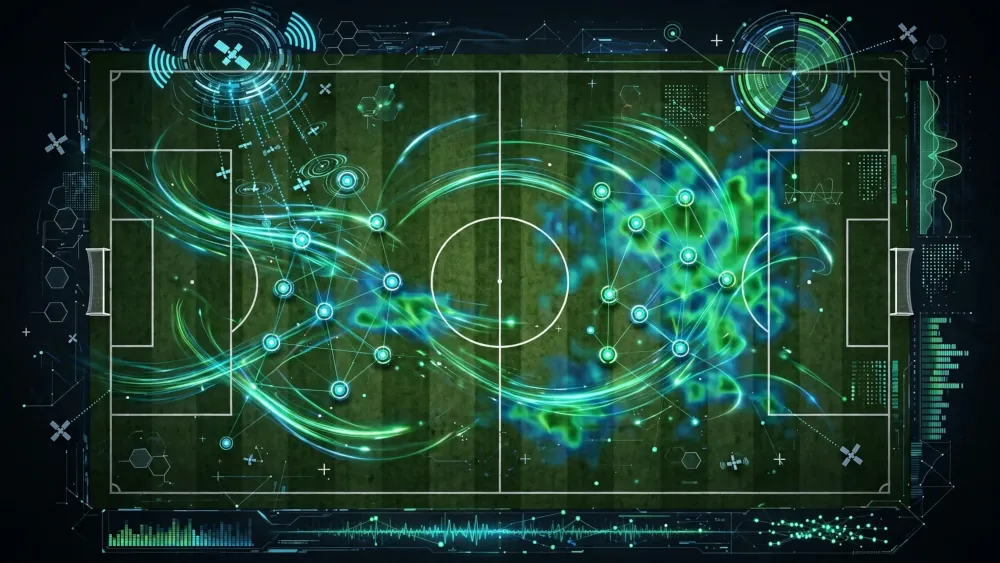
AI player tracking has become an important part of modern football performance analysis. Instead of relying only on manual observation, analysts can use cameras, GPS/GNSS devices, local positioning systems and wearable sensors to capture how players move during training sessions and matches.
These systems can track player position, distance covered, speed, acceleration, deceleration and high-speed running. When combined with event data and machine learning, tracking data can also help analysts understand movement patterns, workload and the physical demands of different phases of play.
In Short
In short: AI tracks football players using optical cameras, GPS/GNSS wearables, and inertial sensors. Computer vision detects players, maintains their trajectory across frames, and converts movement into metrics like distance, high-speed running, and accelerations.
For clubs, the value of player tracking is not simply knowing how far a player has run. The objective is to turn movement data into useful information for performance analysis, physical preparation, coaching, player development and recruitment.
What Is Football Player Tracking?
Football player tracking is the process of continuously recording the location and movement of players on the pitch.
A tracking system typically produces positional data at a high frequency, creating a sequence of coordinates that describes where a player was and how that position changed over time.
From this data, performance systems can calculate metrics such as:
- Total distance covered
- Distance covered per minute
- Maximum speed
- High-speed running
- Sprint distance
- Number of accelerations
- Number of decelerations
- Movement intensity
- Work rate
- Positional occupation
- Player-to-player distances
- Team shape and spacing
The exact metrics available depend on the tracking technology, data frequency, methodology and analysis platform.
Player tracking is therefore an important component of football performance analysis, but it is only one part of the broader football analytics process.
How AI Tracks Football Players
Modern tracking systems generally follow a sequence of steps:
- Capture movement data
- Detect players
- Identify individual players
- Track their movement over time
- Calculate physical and positional metrics
- Analyse movement patterns
- Interpret the results in football context
The underlying technology varies depending on whether the system uses cameras, wearable devices or a combination of technologies.
1. Capturing Player Movement
The first stage is collecting information about player movement.
Optical tracking systems use cameras positioned around a stadium or training facility. Computer vision algorithms process video frames and identify players based on their visual characteristics and position on the pitch.
Wearable systems use devices carried or worn by players. GPS and GNSS systems estimate player location and movement outdoors, while local positioning systems can provide positioning within a defined environment.
Inertial measurement units can also contain accelerometers and gyroscopes that capture aspects of physical movement.
Different systems therefore measure movement in different ways, and their outputs should not automatically be treated as interchangeable.
2. Detecting Players
For camera-based tracking, AI first needs to identify players within each frame.
Computer vision models can distinguish players from other objects such as the pitch, advertising boards, officials and the ball.
This is more difficult than simply recognising that a person is present. A football match contains multiple players moving simultaneously, frequent changes in direction and significant visual overlap.
Players can also become temporarily obscured by other players.
3. Maintaining Player Identity
After detecting players, the system must determine which detected player corresponds to which player in previous frames.
This is known as multi-object tracking.
The system attempts to maintain a continuous trajectory for each player as they move across the pitch.
This becomes particularly important when players cross paths or become partially or completely occluded.
A reliable tracking system therefore needs to combine information about position, movement, appearance and temporal continuity rather than treating every video frame as an independent image.
4. Calculating Movement Metrics
Once a player's trajectory has been established, the system can calculate movement metrics.
For example, changes in position over time can be used to estimate speed and acceleration. The accumulated movement trajectory can be used to calculate total distance.
This allows analysts to divide movement into different intensity zones.
A club might therefore examine:
- Low-intensity movement
- Moderate running
- High-speed running
- Sprinting
- Accelerations
- Decelerations
- Distance per minute
These measurements provide a quantitative view of the physical demands placed on players.
Football Player Tracking Technologies
Several technologies are used to track football players.
| Tracking technology | How it works | Typical use |
|---|---|---|
| Optical tracking | Cameras use computer vision to identify and track players on the pitch. | Position, speed, distance and tactical movement |
| GPS/GNSS | Wearable devices estimate player movement and location using satellite positioning. | Distance, acceleration, speed and workload |
| LPS | Local positioning systems track players using infrastructure installed around the venue. | High-frequency positioning in controlled environments |
| Inertial sensors | Accelerometers and gyroscopes measure aspects of player movement. | Acceleration, deceleration and movement load |
| Broadcast video tracking | AI analyses available match video to identify and track players. | Post-match analysis and large-scale video analysis |
Optical Tracking
Optical tracking uses multiple cameras and computer vision to track player movement.
The system can generate positional information without requiring players to wear a tracking device. This makes optical tracking particularly useful for match analysis.
For example, SkillCorner uses computer vision-based tracking technology to provide football tracking data and player movement information.
Optical systems can be used to analyse both individual and team movement, including player positions, distances between players and changes in team shape.
However, optical tracking depends heavily on camera coverage, calibration, image quality and the ability of the tracking system to maintain player identity.
GPS and GNSS Tracking
GPS and GNSS systems normally use wearable devices to capture player movement.
The device records location information and can calculate metrics such as distance, speed and acceleration.
GPS/GNSS tracking is widely used in training and performance environments because it can provide detailed information about individual physical workload.
For example, Catapult One is part of the broader ecosystem of GPS-based player monitoring and performance technology.
Wearable tracking also has the advantage of being available during training sessions where stadium-wide optical tracking infrastructure may not be available.
Local Positioning Systems
Local positioning systems, or LPS, use infrastructure installed within a specific environment to determine player position.
Rather than depending primarily on satellites, these systems establish positioning using local reference points.
LPS can therefore be useful in training facilities and controlled environments where high-frequency positional information is required.
Inertial Sensors
Inertial sensors can include accelerometers and gyroscopes.
These sensors provide information about movement and changes in movement. When combined with other tracking technologies, they can contribute to a more detailed picture of physical workload.
The resulting information can help performance staff understand how demanding a training session or match was for an individual player.
How AI Converts Tracking Data Into Performance Information
Raw tracking data is not automatically meaningful.
A tracking system may produce thousands of positional observations for a single player during a match. AI and analytics systems transform these observations into structured performance information.
The process can involve:
Position → movement → speed → acceleration → intensity → workload → performance interpretation
For example, a player's trajectory can be analysed to determine how much distance they covered at different speeds.
The same trajectory can also be analysed alongside the positions of teammates and opponents to understand the player's movement within the tactical structure of the team.
This is where player tracking becomes more than a simple running-distance measurement.
AI and Movement Pattern Recognition
Machine learning can be used to identify patterns within large volumes of tracking data.
Instead of analysing individual movement events manually, algorithms can process repeated movement sequences across matches or training sessions.
This can help identify patterns such as:
- Repeated high-intensity actions
- Changes in running behaviour
- Positional tendencies
- Team movement patterns
- Changes in workload
- Differences between training and match demands
- Recurring movement sequences
The purpose is not necessarily to replace the analyst.
Instead, AI can make large datasets easier to process and help analysts identify patterns that would be difficult to detect manually.
Combining Tracking Data With Event Data
Tracking data becomes more useful when it is combined with football event data.
Tracking data describes where players moved and how they moved.
Event data describes what happened during the match.
Events can include actions such as passes, shots, tackles, interceptions, carries and other match actions, depending on the data provider.
Combining the two datasets allows analysts to place physical movement into a football context.
For example, rather than simply recording that a player made a high-speed run, analysts can investigate whether that run occurred:
- Before receiving a pass
- During a transition
- To create space
- To press an opponent
- To support an attack
- During defensive recovery
This distinction is important because the same physical action can have very different tactical meanings.
A broader introduction to the analytical side of this process can be found in What Is Football Analytics?.
Tracking Tactical Relationships
Player tracking is also useful for analysing relationships between players.
Because the system records player positions over time, analysts can examine:
- Distances between teammates
- Defensive line height
- Team width
- Team length
- Compactness
- Spacing between units
- Movement during transitions
- Positional rotations
This creates a bridge between physical performance analysis and tactical analysis.
For example, a player may cover relatively little distance but still perform an important tactical role by maintaining the correct position and controlling space.
This is one reason why distance alone should not be treated as a complete measure of football performance.
Comparing Match Periods
AI tracking systems can also help analysts compare different periods of a match.
A performance team might examine the first half against the second half, or compare specific periods following tactical or personnel changes.
Possible questions include:
- Did running intensity decrease?
- Did high-speed activity change?
- Did team spacing change?
- Did the player's positional behaviour change?
- Did workload increase after a tactical adjustment?
These comparisons can provide additional context when reviewing match performance.
Monitoring Training Workload
Player tracking is particularly valuable outside competitive matches.
During training, clubs can monitor workload across sessions and compare the demands of different exercises.
For example, a performance department might compare:
- Training load between sessions
- Individual workload against previous sessions
- Training intensity before and after matches
- High-speed running exposure
- Acceleration and deceleration demands
- Match workload against training workload
This information can support physical preparation and help staff design training programmes that better reflect the demands of competition.
How Accurate Is AI Player Tracking?
Tracking accuracy depends on the technology and the conditions under which it operates.
For optical systems, factors such as camera placement, calibration, image quality, occlusion and tracking methodology can influence the resulting data.
For wearable systems, device placement, signal quality, sampling characteristics and the specific positioning technology can affect measurements.
This is why tracking data should always be interpreted with an understanding of how it was collected.
Independent testing and validation are also important when comparing tracking systems. A performance metric produced by one technology should not automatically be assumed to be identical to the same metric produced by another system.
Limitations of AI Football Tracking
Despite its capabilities, AI tracking does not provide a complete picture of player performance.
Data Quality
Poor positioning data can affect downstream calculations.
Small errors in player position can influence derived measures such as speed, acceleration and distance, particularly when analysing short, high-intensity actions.
Player Role Matters
A winger, centre-back and goalkeeper naturally have different movement profiles.
A lower running distance does not necessarily indicate poor performance.
Metrics must therefore be interpreted in relation to the player's position, tactical role and match context.
Tactical Context Matters
Movement statistics cannot fully explain why a player moved.
A sprint might represent a successful attacking run, a defensive recovery action or movement caused by a tactical rotation.
Tracking data provides the movement evidence, but football expertise is still needed to interpret its meaning.
Tracking Does Not Equal Performance
A player who covers more distance is not automatically performing better.
Football performance involves technical execution, tactical decision-making, positioning, communication and many other factors that cannot be reduced to a single physical metric.
Tracking data should therefore complement, rather than replace, video analysis and football expertise.
How Clubs Use AI Player Tracking
Player tracking can support several areas of football operations.
Performance Analysis
Analysts can use tracking data to quantify movement and compare physical performance across matches and training sessions.
Physical Preparation
Performance staff can monitor workload and assess how training sessions expose players to different movement demands.
Coaching
Coaches can use movement information alongside video and event data to examine tactical behaviours and team structure.
Player Development
Longitudinal tracking data can help clubs monitor how a player's physical profile changes over time.
Recruitment
Tracking information can contribute to player profiling and recruitment analysis, particularly when combined with event, video and contextual data.
Tools and platforms across the football performance and scouting ecosystem can help clubs combine different data sources into broader workflows. The football analysis and scouting category provides an overview of relevant technologies and platforms.
Can AI Tracking Predict Injuries?
Player tracking can contribute to workload monitoring and injury-risk analysis, but tracking data alone cannot reliably determine whether a player will suffer an injury.
High workloads, repeated high-intensity actions and changes in training load can be useful variables for performance and medical teams to monitor.
However, injury risk is influenced by many factors beyond external movement data.
These can include individual physical characteristics, previous injury history, recovery, training exposure and other factors available to the club's medical and performance teams.
AI can therefore support injury-risk assessment, but it should not be treated as an independent injury prediction system.
What AI Player Tracking Cannot Tell You
Tracking data is powerful, but it has clear boundaries.
It can tell you where a player moved, how quickly they moved and how their movement changed over time.
It cannot independently tell you:
- Whether a player's decision was tactically correct
- Why the player chose a particular movement
- Whether a pass was technically well executed
- Whether a player followed the coach's instructions
- Whether a player made the correct decision under pressure
- Whether a player was mentally fatigued
- Whether an individual movement directly caused an injury
These questions require additional information and human interpretation.
The strongest performance workflows therefore combine tracking data with video, event data, coaching information and expert analysis.
The Future of AI Player Tracking
AI player tracking is moving towards increasingly automated and detailed analysis.
Computer vision can reduce the amount of manual work required to obtain tracking information from video. Machine learning can then be applied to increasingly large datasets to identify movement patterns and relationships.
Future systems are likely to place greater emphasis on combining different data sources rather than analysing tracking data in isolation.
This could include the integration of:
- Optical tracking
- GPS/GNSS data
- Local positioning
- Inertial sensors
- Event data
- Video
- Biometric information
- Tactical information
The result is a more comprehensive representation of player performance.
The main challenge is not simply collecting more data. It is determining which information is reliable, relevant and meaningful in the context of football.
Frequently Asked Questions
How accurate is AI football tracking?
AI football tracking can provide highly detailed positional and movement information, but accuracy depends on the tracking technology, calibration, camera coverage, signal quality and processing methodology. Different systems can produce different measurements, so tracking data should be interpreted according to the characteristics of the system that produced it.
Can AI track players from normal broadcast video?
Yes, AI-based computer vision can track players from broadcast video in some circumstances. However, broadcast footage presents challenges such as camera movement, limited viewing angles, player occlusion and changes in image quality. Dedicated tracking systems with controlled camera coverage can provide more consistent tracking information.
What is the difference between GPS and optical tracking?
GPS/GNSS tracking generally uses wearable devices to estimate player movement, while optical tracking uses cameras and computer vision to identify and follow players. GPS/GNSS is particularly useful for wearable player monitoring and training, while optical tracking can provide detailed match-position information without requiring a wearable device.
Does FIFA approve player tracking systems?
FIFA operates the FIFA Quality Programme for Electronic Performance and Tracking Systems (EPTS), which provides testing and certification processes for relevant technologies. FIFA's EPTS framework covers systems including wearable and camera-based tracking technologies. Certification and testing should be distinguished from a general statement that every tracking system is “FIFA approved”.
Can player tracking data predict injuries?
Player tracking data can support workload monitoring and injury-risk analysis, but it cannot independently predict whether a particular player will suffer an injury. Injury risk is influenced by multiple physical, medical and contextual factors, so tracking data should be considered alongside other information.
Final Thoughts
AI player tracking gives football clubs a detailed way to measure movement, workload and positional behaviour.
Optical cameras, GPS/GNSS devices, local positioning systems and inertial sensors can capture different aspects of player movement. AI and computer vision can then transform that raw information into structured tracking data and performance metrics.
The real value comes from combining those measurements with football context.
Distance, speed and acceleration are useful measurements, but they become much more valuable when connected to tactical behaviour, match events, training demands and the player's specific role.
For modern clubs, AI tracking is therefore not simply about counting how much a player runs. It is about turning movement data into information that can support better analysis, preparation, coaching and decision-making.
Related AI Tools

DataMB
DataMB is a football analytics and scouting platform that provides interactive visualizations, player comparisons, team analysis, rankings, and AI-powered scouting tools. It covers more than 40 football leagues and over 20,000 players, helping scouts, analysts, coaches, journalists, fantasy football managers, and fans make data-driven decisions.
