
Hattrick Review: Online Football Management, Tactics, Transfers and Long-Term Club Building
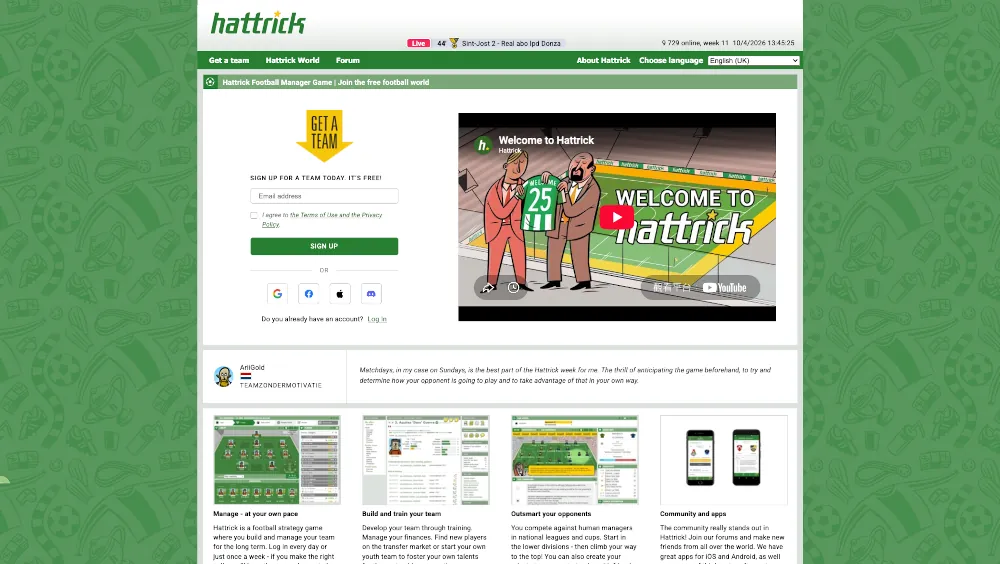
is a long-running online football management game in which players take responsibility for building and running their own clubs. Launched in 1997, it combines squad building, player training, tactical planning, transfers, finances, youth development and competitive matches against teams managed by real people.
Rather than focusing on controlling individual players during a match, Hattrick is built around the decisions made by the club manager. That makes it particularly relevant to football fans who enjoy the strategic side of the game and want a persistent club-building experience rather than a conventional football video game.
The core experience is free to play, with an optional Hattrick Supporter subscription that adds convenience, statistics, customisation and other additional features without providing competitive advantages.
What Is Hattrick?
Hattrick is an online football management simulation centred on long-term club development. After creating a club, the manager is responsible for decisions that affect both the team's immediate results and its development over multiple seasons.
The game covers several interconnected areas of football management:
- Squad building: Recruit and develop players to shape the team over time.
- Tactics: Select formations, tactical approaches and match strategies before fixtures.
- Training: Develop player skills and plan progression over multiple seasons.
- Transfers: Buy and sell players through a global transfer market.
- Youth development: Operate a youth academy and develop younger players.
- Club finances: Balance spending, investment and the wider club economy.
- Stadium development: Make decisions about stadium investment and club growth.
- Competitions: Participate in leagues, cups, private tournaments and international competitions.
- Community: Interact with managers around the world through forums and the wider Hattrick community.
The important distinction is that matches are primarily played between clubs managed by real human players. This gives tactical and squad-building decisions a persistent competitive context rather than limiting the experience to matches against computer-controlled opponents.
For readers exploring the broader landscape of football games and fan games, Hattrick sits firmly on the management and strategy side of the category.
A Football Management Game Built Around Long-Term Decisions
One of Hattrick's defining characteristics is its emphasis on development over time. A manager is not simply preparing one squad for one match; training, transfers, youth development, finances and tactical decisions can all contribute to the direction of a club across multiple seasons.
Player development is therefore an important part of the management cycle. Managers can train players, develop younger talent and decide when buying or selling players makes sense for the squad. The transfer market adds another strategic layer because squad construction is not limited to the players already at the club.
This also means that the game connects several areas of management that are often separated in simpler football games. A decision about player recruitment can affect finances, while training priorities can influence how a squad develops and which tactical options are available later.
For players who enjoy football clubs, teams and management, this interconnected approach is more important than individual match controls.
Tactics and Match Strategy
Hattrick gives managers responsibility for setting formations, tactics and match strategies before games. The focus is therefore on preparation and decision-making rather than manually controlling players once the match begins.
This makes tactical planning a central part of the experience. A manager can consider the available squad, select an appropriate formation and establish a match strategy before the fixture.
Matches can then be followed through the game's live commentary system, with results available for analysis afterwards. This creates a straightforward cycle:
prepare → select the squad and tactics → play the fixture → follow the match → assess the result → adjust future decisions.
For users interested in football strategy and rules, this is a useful way to think about the game: the main challenge lies in making decisions before and across matches rather than controlling every action on the pitch.
Transfers, Training and Youth Development
Squad construction is another major part of the Hattrick experience. Managers can use the transfer market to buy and sell players, while training provides a mechanism for developing the existing squad.
The transfer market can consequently become part of a broader squad-building strategy. Managers may look for players who fit their intended team structure, while also considering how their existing players can develop through training.
Youth development provides another route for building a club. The youth academy allows managers to develop younger players rather than relying exclusively on transfers.
Together, these systems give club development several moving parts:
- identifying players through the transfer market
- deciding which players to retain
- training the squad over time
- developing younger players
- aligning recruitment and development with tactical plans
- managing the financial consequences of squad decisions
This is different from a short-form football game where squad changes are mainly about immediate match performance. Hattrick instead makes squad construction part of a longer management cycle.
Managing the Club Beyond the Pitch
The role of the manager extends beyond tactics and players. Hattrick also includes financial management, stadium investment and fan satisfaction.
That broader responsibility is important because running a football club involves balancing sporting ambitions with resources. In the game, managers therefore have to consider the club as an organisation as well as a team.
Financial decisions can sit alongside transfer and training decisions, while stadium development and fan satisfaction form part of the wider club-management experience.
For anyone interested in sports management and clubs, this broader scope is one of the more relevant aspects of the product. It makes the game about managing a football organisation rather than simply selecting a starting eleven.
Multiplayer Competition and the Hattrick Community
Hattrick is fundamentally designed around competition between human-managed clubs. Managers can compete in national leagues and cup tournaments, while also participating in private tournaments and other forms of competition.
The game also extends beyond individual clubs. Managers can interact through forums and the global community, creating a social layer around the management simulation.
International competition is part of that broader structure as well. The documented gameplay features include World Cups for senior and U21 teams, as well as the opportunity to run for national team manager positions.
This combination of persistent club development and human competition gives the game a community-driven character. The objective is not simply to complete a predefined career mode; the club exists within an ongoing competitive environment shaped by other managers.
How Much Time Does Hattrick Require?
Hattrick is designed for long-term strategic play rather than requiring constant attention throughout the day. The supplied product information indicates that users can compete effectively with around 30 minutes per week spent making important decisions, although dedicated managers can spend considerably more time analysing their clubs and looking for ways to improve them.
That makes the game suitable for players who enjoy strategic football management but do not necessarily want a management simulation that demands continuous daily involvement.
The distinction is useful for prospective players: Hattrick's depth comes from the accumulation of decisions across seasons, not from needing to control every match action in real time.
Web and Mobile Access
Hattrick is available through web browsers as well as official iOS and Android applications. The mobile apps allow managers to handle most club-management tasks away from a computer.
That accessibility suits the game's management-oriented format. Since the core activity involves decisions about tactics, training, transfers and club operations rather than real-time player control, managers can keep up with their clubs from different devices.
The game also supports multiple languages, including English, Chinese, Spanish, French, German, Korean, Portuguese, Russian and Vietnamese, among other languages.
Is Hattrick Free to Play?
The core Hattrick experience is free. The free experience includes club management, matches, leagues, training, transfers, youth development and multiplayer competition.
There is also an optional Hattrick Supporter subscription. According to the supplied product information, Supporter adds features such as enhanced statistics, improved reports, additional customisation, transfer-market tools and other convenience features.
Importantly, the paid membership does not provide competitive advantages. Hattrick's documented approach is therefore not based on allowing players to purchase improvements to their team's competitive strength.
| Plan | Access |
|---|---|
| Free Plan | Core club management, matches, training, transfers, leagues, competitions and youth development |
| Hattrick Supporter | Additional statistics, reports, customisation, transfer tools and convenience features |
Who Is Hattrick For?
Hattrick is particularly suited to football fans who enjoy the strategic and organisational side of the sport.
It can make sense for:
- Football management fans who enjoy building a club over multiple seasons.
- Tactical players who prefer planning formations and match strategies.
- Squad-building enthusiasts who enjoy transfers and player development.
- Players interested in youth development and turning younger players into future contributors.
- Football fans seeking multiplayer competition against real managers.
- Mobile users who want to manage a club through iOS or Android.
- Football communities interested in an ongoing competitive management environment.
It is less about direct match control and more about the decisions surrounding a football club: who to sign, who to train, how to set up for a fixture, how to develop the club and how to compete over the long term.
Final Take
Hattrick offers a distinctly management-focused interpretation of football gaming. Its core experience combines tactics, training, transfers, youth development, finances and club growth within an online environment where teams are managed by real people.
Its long-term structure is particularly relevant for players who enjoy game modes and simulations and want their decisions to extend beyond a single match. The free core experience also gives users access to the essential management and competitive systems, while the optional Supporter membership adds convenience and customisation without giving paying users a competitive advantage.
For football fans interested in the strategic side of running a club, Hattrick provides a persistent online setting in which squad building, tactical preparation and long-term development are the main focus.
Related AI Tools

Hattrick
Hattrick is a free online football manager strategy game where players build, train, and manage their own football clubs while competing against real human managers worldwide. The game focuses on long-term team development, tactical planning, player transfers, youth academy management, financial strategy, and community competition.