
How AI Helps Analyse Football Matches
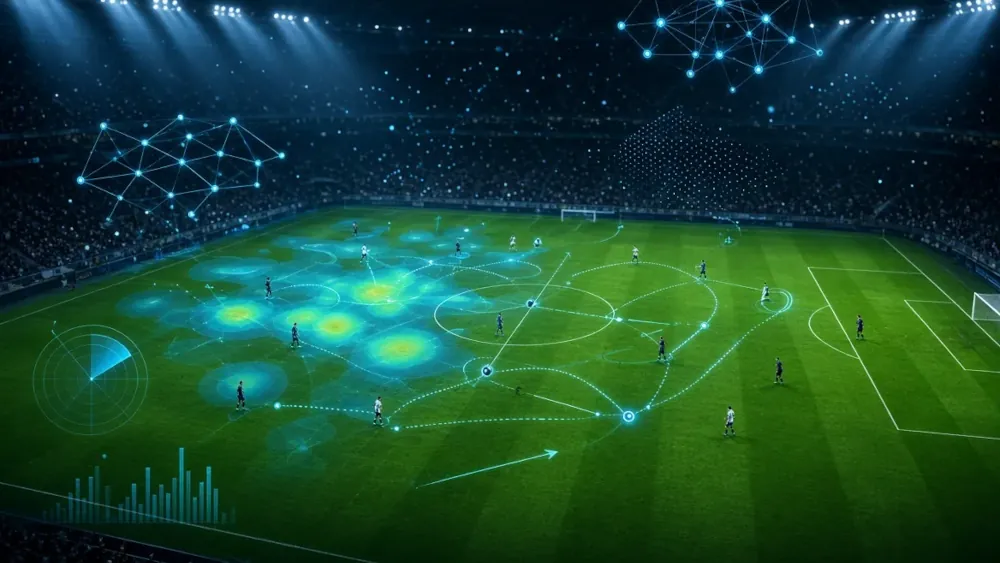
AI can help football analysts turn large amounts of match footage, event data and player-tracking information into more structured and actionable insights. Instead of relying entirely on manual video review, analysts can use AI to identify events, track player movement, recognise tactical patterns, compare phases of play and organise information for further analysis.
The important point is that AI does not replace football analysis. Its value is in processing large volumes of information and helping analysts find patterns that can then be interpreted in their tactical and competitive context.
Modern football match analysis can combine several types of information, including event data, tracking data, video, physical measurements and historical match records. AI and machine learning can help connect these sources and make parts of the analytical workflow faster and more detailed.
This article explains how AI is used to analyse football matches, what data it works with, which aspects of a game it can examine, and where human judgement remains essential.
What Does AI Match Analysis Mean in Football?
AI match analysis refers to the use of artificial intelligence and machine learning techniques to process football match information and identify patterns, events, movements or relationships that may be useful for analysis.
Traditional performance analysis often involves watching match footage, tagging relevant events, creating clips and reviewing tactical situations. AI can automate or assist with parts of this process.
For example, a system may help identify:
- Player and ball locations.
- Passes, shots and other match events.
- Player movements and running patterns.
- Changes in team shape.
- Pressing and defensive actions.
- Attacking runs and combinations.
- Transitions between attacking and defensive phases.
- Repeated tactical situations.
- Statistical patterns across multiple matches.
This creates a connection between raw match information and the football questions that analysts need to answer.
For a broader introduction to the analytical discipline, see What Is Football Analytics? A Guide to Football Data Analysis.
What Data Does AI Use to Analyse a Football Match?
AI match analysis depends heavily on the quality and type of data available. Different data sources describe different parts of the game, and combining them can provide a more complete picture.
Event Data
Event data records actions that occur during a match. Depending on the data provider and collection method, this can include passes, carries, shots, tackles, interceptions, fouls, clearances and other on-ball or off-ball events.
Event data is useful for analysing what happened during a match.
For example, an analyst could examine where a team recovered possession, how often it progressed the ball through certain areas, or which types of attacking actions preceded shots.
AI can process large event datasets and identify recurring patterns across individual matches, opponents or longer periods.
Tracking Data
Tracking data describes the locations and movements of players, and in some systems the ball, over time.
Unlike event data, tracking data is not limited to actions that are explicitly recorded as events. It can show how players move before, during and after those actions.
This makes it particularly useful for analysing:
- Team shape.
- Defensive distances.
- Player positioning.
- Off-ball runs.
- Pressing movements.
- Space between lines.
- Compactness.
- Width and depth.
- Changes in formation during different phases.
UEFA's technical analysis of EURO 2024, for example, describes the use of multi-camera optical tracking to track players and the ball frame by frame. The resulting tracking data can then be analysed to understand physical and positional behaviour.
Modern commercial systems can combine tracking data with event data. Stats Perform's Opta Vision, for example, describes a dataset that synchronises player tracking with event information and uses AI-enriched metrics to analyse areas such as team shape, off-ball runs, pressure and passing decisions.
Video Data
Match video provides visual context that structured data alone cannot always capture.
Computer vision models can analyse footage to identify players, the ball and relevant areas of the pitch. Player positions can then be transformed from the camera view into football-pitch coordinates, allowing movement and spatial relationships to be analysed computationally.
FIFA's research programme includes work on computer vision, player and ball tracking and automated event detection. It is also investigating approaches that could generate tracking information from standard broadcast footage, potentially making advanced analysis more accessible.
Video analysis therefore provides an important bridge between what happened on the pitch and the structured information that AI models can process.
How AI Analyses Player Movement
One of the most useful applications of AI in match analysis is understanding movement rather than simply counting actions.
A pass, for example, does not exist in isolation. The positions of the passer, receiver, opponents and other teammates can influence its tactical meaning.
With tracking information, AI systems can examine movement before and after an event.
An analyst might therefore investigate questions such as:
- Did a midfielder move towards the ball to create a passing option?
- Did a winger attack the space behind the full-back?
- How quickly did a defensive line retreat after losing possession?
- Which players created space for a teammate's progression?
- How did the team's structure change when possession moved into the final third?
AI can process these spatial relationships across thousands of sequences, making it possible to search for recurring behaviours that would be difficult to identify manually across every minute of every match.
Some systems can also classify specific types of movement. Opta Vision, for example, describes automated identification of attacking and defensive off-ball runs and analysis of changes in team shape.
AI for Tactical Analysis
Tactical analysis is concerned with how a team behaves collectively.
AI can help analysts move beyond a static formation such as 4-3-3 or 4-2-3-1 and examine how the team actually behaves during different phases of play.
A team listed as playing a 4-3-3 may adopt different structures:
- During build-up.
- When pressing high.
- When defending in a mid-block.
- After losing possession.
- During sustained possession.
- When protecting a lead.
Tracking data can help identify these changes by measuring the relative positions of players over time.
Analysing Team Shape
AI can analyse the distances and relationships between players to identify recurring team structures.
For example, an analyst might compare:
- The average position of the back line.
- The distance between defensive and midfield lines.
- The width of the team in possession.
- The positioning of full-backs during build-up.
- The team's shape immediately after losing possession.
This type of analysis can reveal that a team's practical structure differs from its nominal formation.
AI-based shape analysis is already used commercially. Stats Perform describes systems that automatically identify team shapes in and out of possession and detect changes in those shapes during matches.
Analysing Pressing
Pressing is another area where movement data can add context.
A simple event dataset might record a defensive action or possession recovery. Tracking data can show what happened around that event.
An AI system could examine:
- The distance between the presser and the ball carrier.
- The movement of nearby defenders.
- The availability of passing options.
- The position of the defensive line.
- Whether the team moved forward collectively.
- What happened immediately after the pressure was applied.
This helps distinguish an isolated defensive action from a broader pressing sequence.
The result is not necessarily a single "pressing score". More useful analysis may involve several measurements that help an analyst understand how and why a pressing structure worked or failed.
AI for Attacking and Chance Creation Analysis
AI can also help examine how teams create opportunities.
Traditional statistics such as shots, goals and assists describe outcomes, but match analysis often needs to investigate the sequences that produced those outcomes.
AI can combine event and positional information to examine patterns such as:
- Where attacks begin.
- How possession progresses through the pitch.
- Which passing combinations occur repeatedly.
- How players create space for one another.
- Where final-third entries originate.
- How often attacks exploit particular areas.
- Which movements precede dangerous chances.
Expected goals (xG) can also be used as part of this broader analytical process. An xG model estimates the probability that a shot will result in a goal based on characteristics of the chance. It provides useful information about shot quality, but it does not by itself explain the complete tactical sequence that created the opportunity.
This distinction matters because two teams can produce similar shot totals while creating those shots through very different attacking structures.
AI for Defensive Analysis
Defensive analysis presents a similar challenge because many important actions happen away from the ball.
A defender may contribute without making a tackle or interception by:
- Blocking a passing lane.
- Maintaining the correct distance from a teammate.
- Covering space behind another defender.
- Preventing a forward from receiving between the lines.
- Delaying an attack.
- Coordinating movement with the defensive line.
Tracking data gives AI models information about these off-ball relationships.
Research into machine learning for football defence is increasingly exploring ways to evaluate defensive roles and contributions from tracking data rather than relying only on conventional on-ball statistics.
This is an important development because defensive performance is often difficult to represent with a small number of traditional statistics.
AI for Match Phases and Transitions
Football matches can also be analysed according to phases of play.
A possession may begin with a goalkeeper or centre-back, progress through midfield, enter the final third and end with a shot, loss of possession or defensive intervention.
AI can help classify these sequences and identify patterns across many possessions.
For example, an analyst may want to know how a team behaves:
- Immediately after winning the ball.
- Immediately after losing the ball.
- During build-up.
- During progression.
- During sustained possession.
- During a high press.
- When defending a low block.
This type of classification allows analysts to compare similar situations rather than treating every match as one continuous sequence.
Some commercial data systems already provide phase-of-play classifications alongside tracking and event data.
AI Can Make Video Analysis More Efficient
One of the practical benefits of AI is reducing the amount of manual work involved in finding relevant match footage.
Instead of an analyst manually searching through an entire match for every example of a particular situation, an AI-assisted workflow can help locate relevant sequences.
For example, a coach might want to review:
- Every time the opposition pressed a particular build-up structure.
- All attacks that began with a specific type of regain.
- Every instance in which a winger received the ball in a certain zone.
- Defensive sequences immediately following a turnover.
The analyst can then review the selected clips and determine what is tactically significant.
This distinction is important: automated detection can reduce the search burden, but the football interpretation still requires context.
FIFA's Football AI Pro illustrates this direction by combining structured event and tracking data with video and a football-specific language model to support post-match analysis and report generation for analysts and coaching staff.
AI Can Compare Matches and Opponents
Another advantage of AI is scale.
A human analyst can study an individual match in considerable detail, but comparing dozens of matches consistently is much more demanding.
AI can help standardise the process by applying the same analytical framework across multiple fixtures.
For opposition analysis, this could involve comparing:
| Area | Example question |
|---|---|
| Build-up | How does the opponent progress the ball from the defensive third? |
| Pressing | When and where does the opponent initiate pressure? |
| Transitions | What happens immediately after possession changes? |
| Attacking | Which areas are most frequently used to create chances? |
| Defensive shape | How does the team structure itself without the ball? |
| Set pieces | Which patterns or delivery zones recur? |
The purpose is not to produce an automatic tactical verdict. Instead, AI can help analysts organise evidence so that they can investigate the most relevant questions more efficiently.
AI and Match Analysis Reports
AI can also assist with turning structured information into reports.
A modern workflow may involve:
- Collecting event, tracking and video data.
- Organising the data according to football concepts.
- Identifying relevant sequences and statistical patterns.
- Presenting the findings through dashboards, clips or visualisations.
- Generating an initial written summary.
- Having an analyst or coach review and interpret the findings.
The final stage remains particularly important.
A generated statement such as "the team struggled against pressure" is much less useful than evidence showing when pressure caused problems, where it happened, which players were involved and what alternative solutions may have been available.
AI can help organise that evidence, but football staff still need to decide what it means.
What AI Cannot See From Data Alone
AI match analysis has important limitations.
Data quality matters
Models are only as useful as the information they receive. Missing events, inconsistent definitions, inaccurate tracking or differences between data providers can affect the resulting analysis.
Tactical context matters
A player's movement can have several possible explanations.
A centre-back stepping forward might represent aggressive defending, planned build-up behaviour or a response to a specific match situation. Positional data alone may not explain the coaching intention.
Models are not automatically objective
An analytical model reflects its inputs, definitions and design choices. Different models can produce different estimates or classifications.
This is particularly important when analysing concepts that are difficult to define precisely, such as defensive contribution, pressing effectiveness or tactical intent.
Small samples can mislead
A single match contains relatively few examples of many football situations. Analysts should be cautious about drawing broad conclusions from one unusual sequence or a small number of events.
Human interpretation remains essential
Football analysis is not simply a process of finding correlations in data.
Coaches and analysts need to connect evidence with tactical objectives, opposition behaviour, player roles, match state and competitive context.
This is why AI is better understood as an analytical assistant than as an automatic replacement for football expertise.
How AI Match Analysis Fits Into the Wider Football Analytics Process
AI match analysis sits within the broader discipline of football analytics.
Football analytics can include player evaluation, recruitment, performance analysis, opposition analysis, scouting, forecasting and other forms of data-supported decision-making.
AI is one set of technologies that can be applied within those workflows.
A useful distinction is:
- Football analytics describes the broader analytical discipline.
- Match analysis focuses on understanding what happened during a game and why.
- Performance analysis examines team and player performance to support improvement.
- AI provides computational methods that can automate, classify, predict or summarise parts of these processes.
This means that AI match analysis should not be treated as a separate replacement for established football analysis. It is increasingly becoming part of the technology stack used to support it.
The Future of AI Football Match Analysis
The direction of development is towards richer combinations of video, tracking, event data and AI models.
FIFA's research programme is investigating computer vision, automated event detection and methods for making player and ball tracking more accessible from broadcast footage.
At the same time, commercial systems are combining tracking and event data to produce more detailed measurements of movement, team structure and decision-making.
These developments could make it easier to analyse aspects of football that were previously difficult to quantify, particularly off-ball movement and collective tactical behaviour.
The challenge will be ensuring that greater analytical detail does not create more noise than useful information. The most valuable systems will be those that connect data to meaningful football questions rather than simply producing more metrics.
Final Thoughts
AI helps analyse football matches by processing information that would be difficult to examine manually at the same scale. Event data can describe what happened, tracking data can show where players moved, computer vision can extract information from video, and machine learning can identify patterns across these sources.
These capabilities can support tactical analysis, player movement analysis, pressing analysis, chance creation, defensive evaluation, transition analysis, opposition scouting and post-match reporting.
But AI does not remove the need for football expertise. The difficult part of match analysis is not only detecting a pattern; it is deciding whether the pattern matters, understanding its tactical context and translating the evidence into a useful football decision.
For analysts and coaching staff, the practical value of AI therefore lies in making large volumes of match information easier to search, compare and interpret while keeping human judgement at the centre of the analytical process.