
How AI Is Used in Football Analytics: From Match Data to Tactical Insights

Football produces enormous amounts of information during every match. Every pass, shot, defensive action and off-the-ball movement can contribute to understanding how a team plays. The challenge for analysts is no longer simply collecting this information. It is turning complex football data into insights that coaches, scouts and recruitment teams can actually use.
Artificial intelligence is expanding what football analytics can achieve. Machine learning models can estimate the quality of scoring opportunities, computer vision can help track players across the pitch, and automated systems can identify patterns across thousands of match events.
However, AI does not replace football expertise. Its value lies in helping analysts investigate tactical questions, identify meaningful patterns and communicate evidence that supports better-informed decisions.
This guide explores how AI is used in football analytics, the technologies behind it, practical applications in professional football and the limitations that analysts need to understand.
What Is AI in Football Analytics?
AI in football analytics refers to the use of artificial intelligence techniques to process football data, identify patterns, generate predictions and support match or player analysis.
Traditional football analytics often relies on descriptive statistics such as possession percentage, pass completion, shots and tackles. These metrics remain useful, but they cannot fully explain the tactical context surrounding individual actions.
AI-based approaches can incorporate additional information, including player positions, defensive pressure, movement trajectories and the sequence of events preceding a particular action.
For example, two players might complete the same number of passes, but those passes may have very different tactical effects. One player might repeatedly circulate possession between defenders, while another progresses the ball through opposition lines.
Advanced analytical models can help distinguish between these contributions by evaluating where passes occur, the defensive structures they encounter and how they change the attacking team's position.
Not every advanced football statistic uses AI. Expected goals models, for instance, can be built using conventional statistical methods or machine learning. The distinction matters because the quality of an analytical model depends on its data, assumptions and validation rather than whether it carries an AI label.
For a broader introduction, read What Is Football AI? or explore the Football Analysis, Data & Scouting directory.
1. How AI Analyses Football Match Data
The foundation of AI-powered football analytics is the combination of different types of match data. Each provides a different perspective on what happens during a game.
Event Data: Understanding What Players Do
Event data records individual actions, such as passes, shots, interceptions, tackles, carries and fouls. Depending on the provider, records may also include the location, timing, outcome and circumstances of each event.
Machine learning can use this information to investigate questions that conventional match statistics cannot answer directly.
For example, an analyst examining a midfielder might want to know whether their passing helps a team progress through defensive lines. Rather than looking exclusively at pass completion, a model could evaluate the location of each pass, its direction and the attacking value of the resulting possession.
Platforms such as StatsBomb and Hudl Wyscout provide football data and analytical resources that support professional match and player analysis.
Tracking Data: Understanding What Happens Without the Ball
Event data describes individual actions, but much of football takes place between those actions.
Tracking systems capture the changing positions of players and, where supported, the ball. Optical cameras, local positioning systems and wearable devices can provide different types of movement information.
Computer vision and machine learning can then help analysts investigate:
- How a defensive line moves when opponents circulate possession.
- Whether midfielders maintain appropriate distances between one another.
- How attacking players create space through off-the-ball runs.
- Whether a team's pressing structure leaves exploitable passing lanes.
- How quickly players and defensive units reorganise after losing possession.
Tracking data is particularly valuable because an important tactical contribution may never appear in conventional event statistics.
A forward who makes a decoy run, for instance, may create space for a teammate without touching the ball.
FIFA's Electronic Performance and Tracking Systems programme establishes safety and performance testing standards for wearable and optical tracking technologies. These standards underline the importance of measurement accuracy when interpreting positional and movement data.
Video Data: Connecting Numbers to Football Situations
Video analysis adds the visual context needed to interpret statistical findings.
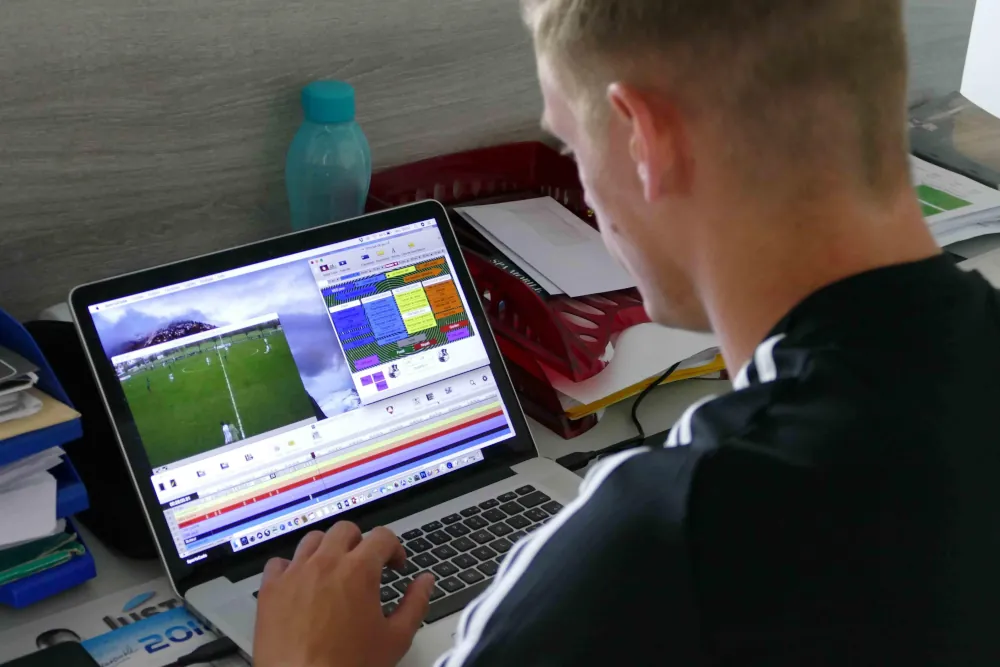
AI-assisted video systems can help identify actions, follow players and organise footage into searchable sequences. The precise level of automation depends on the system and the quality of the available footage.
An analyst could use video alongside event data to review every occasion when an opponent progressed through the centre of the pitch. Instead of manually searching an entire match, they can begin with relevant sequences and examine the tactical circumstances surrounding each event.
Tools such as Hudl, Metrica Sports and Nacsport are relevant to video-based analysis workflows, although their capabilities and degree of AI automation differ.
2. Expected Goals and AI-Powered Chance Analysis
Expected goals, commonly abbreviated as xG, is one of the most established concepts in modern football analytics.
An xG model estimates the probability that a particular shot will result in a goal, based on information about the shooting opportunity.
A shot assigned an xG value of 0.30, for example, represents an estimated 30% probability of scoring under the model's assumptions. It does not mean that the player should score three times from their next ten shots.
How Machine Learning Improves xG Models
Basic xG models may use shot distance, angle, body part and type of assist. More sophisticated models can incorporate additional information, such as goalkeeper positioning, defensive pressure and the positions of other players.
Machine learning is particularly useful when models need to identify complex relationships between these variables.
Consider two shots taken from approximately the same position inside the penalty area. One might be an uncontested attempt following a cutback, while the other occurs with several defenders blocking the shooting lane.
A model incorporating relevant positional information can distinguish between the two situations more effectively than one using shot location alone.
However, xG values from different providers are not necessarily interchangeable. Their datasets, modelling techniques and available contextual information can differ.
Beyond xG: Evaluating Attacking Possession
AI and advanced statistical models can also estimate how individual actions change the value of possession.
Expected threat (xT) and possession-value models are examples of approaches that evaluate the potential attacking benefit of moving the ball into particular areas or progressing through a sequence of actions.
These models can help identify players who contribute to creating opportunities without necessarily registering the final pass or shot.
For example, a midfielder who regularly breaks an opposition press may contribute substantially to attacking development even if their direct goal involvement remains limited.
For practical examples of publicly accessible football statistics, explore FBref, Understat and FotMob. Their datasets and available metrics differ, so analysts should check each provider's definitions before comparing results.
3. AI in Tactical Analysis and Opposition Preparation
One of the most valuable applications of AI in football analytics is identifying tactical patterns that would otherwise require extensive manual video review.
Machine learning can help analysts examine recurring movements, team structures and relationships between players across multiple matches.
Analysing Pressing and Defensive Organisation
Pressing analysis is not simply about counting how often a team attempts to regain possession.
An effective press depends on collective positioning, timing, the direction of pressure and the ability to restrict the opposition's passing options.
With sufficiently detailed tracking data, analytical models can investigate how teams coordinate their movements, which passing lanes remain available and where opponents repeatedly escape pressure.
For example, a coaching staff preparing to face a high-pressing opponent might investigate whether that opponent consistently leaves space behind its full-backs when pressing near the touchline.
The resulting analysis could inform training exercises and match preparation. Coaches would still need to determine whether exploiting that space is realistic for their own players.
Identifying Attacking Patterns
AI-assisted pattern recognition can help identify recurring attacking sequences, including wide overloads, third-man combinations, overlapping runs and transitions following possession recoveries.
Sequence-based models can examine how individual actions relate to subsequent events rather than treating every pass or carry as an isolated occurrence.
This can help analysts compare how different teams create opportunities and identify the situations in which particular attacking structures are effective.
A Real-World Example: TacticAI and Liverpool FC
A documented example of AI-assisted tactical analysis is TacticAI, developed through a research collaboration between Google DeepMind and Liverpool FC.
Published in Nature Communications in March 2024, the research focused on corner kicks and used geometric deep learning to model relationships between players.
The system was designed to predict potential corner-kick receivers, estimate whether a routine might produce a shot and suggest alternative player positioning.
Its research dataset contained 9,693 corner kicks from Premier League matches across the 2020–21, 2021–22 and part of the 2022–23 seasons.
In a blind evaluation involving Liverpool FC football experts, AI-generated tactical suggestions were preferred to the original setups in 90% of the evaluated cases.
This was an expert-preference result in a specific research setting, not evidence of a 90% improvement in scoring or match results.
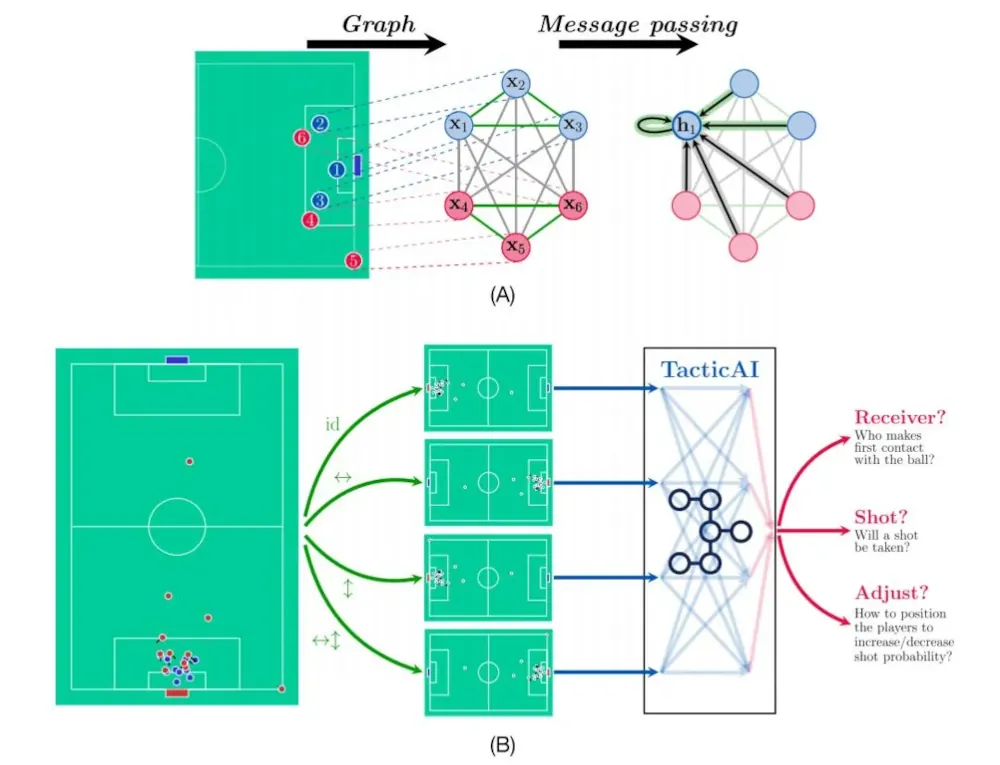
The research demonstrates how AI can support tactical investigation by presenting coaches with additional scenarios to examine.
It does not establish that AI-generated tactical recommendations will consistently outperform human coaching decisions in competitive matches.
For further information, see the published TacticAI research paper.
Analysts interested in practical tactical workflows can also explore Metrica Sports, LongoMatch and zone14 REPLAY.
4. How AI Supports Player Performance Analysis
Individual player evaluation is another important application of AI in football analytics.
Traditional performance analysis frequently concentrates on measurable outcomes: goals, assists, successful passes, tackles and distance covered. Although these statistics provide useful information, they do not fully explain a player's contribution within a particular tactical system.
AI-assisted models can help analysts investigate performance in greater context.
Evaluating Players Beyond Traditional Statistics
Consider two central midfielders with similar passing accuracy.
One regularly receives possession under pressure, turns away from opponents and progresses the ball into advanced areas. The other mainly completes short passes in relatively uncontested positions.
Their passing accuracy may be similar, but their tactical contributions are different.
Advanced analytical models can examine progressive actions, ball retention under pressure, possession value and the circumstances in which a player receives the ball.
Similarly, defensive evaluation can extend beyond tackles and interceptions to examine positioning, defensive coverage and the ability to restrict an opponent's options.
These approaches are especially useful when comparing players operating in different tactical systems.
Comparing Players Across Competitions
Player comparisons become more complicated when evaluating footballers from different leagues.
Competition strength, team possession, playing style and individual responsibilities can all influence statistical output.
Machine learning can help identify relationships between these factors and a player's recorded performance. Some recruitment models also attempt to estimate how performance might translate to a different competitive environment.
Such projections should be interpreted carefully. A model trained on historical transfers cannot fully account for adaptation, coaching relationships, changes in tactical responsibilities or individual development.
Tools relevant to advanced player evaluation include DataMB, Comparisonator, SciSports and Impect.
5. AI in Football Scouting and Recruitment Analytics
Football recruitment departments frequently need to evaluate large numbers of potential signings across different leagues and age groups.
AI can support this process by identifying players whose statistical profiles match specific recruitment requirements.
Rather than simply ranking players by goals or assists, analytical systems can examine combinations of attributes associated with particular playing roles.
For example, a club searching for a progressive centre-back might investigate passing under pressure, ball progression, defensive positioning and performance in aerial duels.
Machine learning can help identify candidates with similar statistical characteristics and highlight players who might otherwise receive limited attention.
From Statistical Shortlist to Recruitment Decision
A practical data-assisted recruitment process could involve identifying the required player profile, screening a database for relevant attributes and evaluating candidates against comparable players.
Analysts would then review match footage, assess tactical compatibility and investigate whether the player's performance is sustainable.
The final recruitment decision also depends on factors that statistical models cannot reliably establish, including medical assessments, contractual considerations and the club's broader sporting strategy.
Platforms such as Hudl Wyscout, Driblab, SciSports and TransferRoom support different aspects of scouting, performance evaluation and recruitment. They should not be treated as interchangeable AI systems.
Explore more resources in Scouting & Recruitment.
6. AI in Player Tracking and Physical Performance
AI-powered analytics also extends to physical performance monitoring.
Tracking technologies can capture information about player movement, including distance covered, speed, acceleration and changes of direction.
Computer vision can assist with extracting positional information from video, while machine learning can help identify patterns in movement and training workloads.
Football performance departments can use this information to investigate whether players are meeting the physical demands of their positions and how their workloads change across training sessions and matches.
Monitoring Training Load
A performance analyst might examine a player's high-speed running, sprint exposure and acceleration patterns over several weeks.
Changes in these measurements may prompt further investigation, particularly when considered alongside training schedules, match congestion and individual recovery information.
However, physical tracking data alone cannot determine whether a player is fatigued or predict when an injury will occur.
Measurement accuracy, individual baselines and the wider medical context are essential. FIFA maintains a quality programme for electronic performance and tracking systems, including performance testing of positional and velocity measurements.
Relevant platforms include STATSports, Catapult One, KINEXON Sports and PlayerData EDGE.
Further options are available in Football Performance & Tracking.
7. How Football Analysts Can Build an AI-Assisted Workflow
Introducing AI into football analytics does not necessarily require a club to develop its own machine learning models.
A practical starting point is to identify a specific football question and determine which data and analytical methods can help answer it.
Example: Analysing an Opponent's Build-Up Play
Consider a performance analyst preparing a report on how an upcoming opponent progresses the ball against a high press.
The following workflow illustrates how AI-assisted analysis can support the process.
Step 1: Define the analytical question
Establish what the coaching staff needs to understand. In this example, the central question is how the opponent progresses possession when facing coordinated high pressure.
Step 2: Collect relevant match data
Gather recent match footage, passing events and positional data where available. Prioritise matches in which the opponent faced comparable pressing structures.
Step 3: Identify recurring patterns
Use analytical tools to examine preferred passing routes, player movements and areas where the opposition regularly bypasses pressure.
Step 4: Validate the findings with video
Review representative sequences and investigate alternative explanations. Determine whether the identified patterns remain consistent across different match situations.
Step 5: Communicate tactical findings
Prepare a concise report with relevant video clips, supporting evidence and possible tactical responses.
The objective is not to generate the largest possible collection of statistics. It is to produce findings that coaches can understand, evaluate and translate into training or match preparation.
Analysts working with limited resources can begin with accessible statistical platforms and manually tagged video before investing in more sophisticated tracking or machine learning infrastructure.
For example, StatsBomb Open Data provides a starting point for exploring football event data, while FBref offers accessible statistical information.
For a broader explanation of the underlying technology, read How Football AI Works: From Match Data to Tactical Insights.
8. Limitations of AI in Football Analytics
Despite its potential, AI-powered football analytics faces several important limitations.
Data Quality and Availability
Professional tracking data can be expensive or difficult to access. Incomplete event records, tracking errors and inconsistent definitions can undermine analytical results.
Tactical Context
A model might identify a statistically unusual performance without understanding the specific instructions given to a player.
Football analysts must distinguish between individual decisions and responsibilities imposed by the team's tactical structure.
Small Samples and Changing Conditions
A handful of matches may not provide enough evidence to establish reliable patterns.
Opponents, formations, personnel and tactical instructions can also change significantly over a season.
Model Transparency
Some machine learning systems produce outputs that are difficult to interpret.
Analysts need to understand what a model measures, how it was validated and where its predictions become unreliable.
Prediction Versus Causation
An association between a particular movement pattern and successful attacking outcomes does not necessarily establish that the movement caused those outcomes.
Cost and Operational Complexity
Advanced analytical infrastructure may require specialist personnel, reliable data pipelines and ongoing maintenance.
Not every club needs the same level of technical sophistication.
These limitations reinforce the importance of combining statistical evidence with video analysis, coaching expertise and knowledge of the competitive environment.
9. The Future of AI in Football Analytics
Future developments in football analytics are likely to involve closer integration of event data, tracking information, match footage and machine learning.
Multimodal analytical systems could make it easier to investigate a tactical question using several types of evidence simultaneously.
Advances in computer vision may also reduce the manual work required to extract useful information from video, potentially making certain analytical techniques more accessible to clubs with smaller budgets.
Another area of research involves counterfactual analysis: estimating what might have happened if a player had passed to a different teammate, moved into another position or chosen an alternative defensive action.
TacticAI demonstrates one application of this approach in set-piece analysis, although extending similar methods to the complexity of open play remains a substantial research challenge.
The long-term value of these developments will depend on their reliability, accessibility and ability to answer meaningful football questions.
Conclusion
AI is changing football analytics by allowing analysts to investigate more information, examine complex relationships and evaluate aspects of performance that traditional statistics struggle to capture.
Its applications range from expected goals and possession-value models to tactical pattern recognition, player evaluation, recruitment and physical performance monitoring.
Yet sophisticated models are not automatically better models. Their usefulness depends on the quality of their data, the questions they address and the expertise of the people interpreting their results.
For football clubs, the most productive approach is to treat AI as an analytical resource that complements scouting, coaching and performance expertise.
Explore Football AI tools on AICUP.tools to discover platforms for match analysis, scouting, performance monitoring and tactical preparation.
Frequently Asked Questions
How is AI used in football analytics?
AI is used to process match data, analyse player movements, identify tactical patterns and estimate the probability of certain match events. Applications include expected goals modelling, opposition analysis, recruitment analytics and player performance evaluation.
What is the difference between AI and traditional football analytics?
Traditional analytics often uses descriptive statistics and conventional statistical models. AI-based approaches can incorporate machine learning, computer vision and other techniques to identify complex patterns. The two approaches frequently overlap, and not every advanced football metric requires AI.
Can AI analyse football tactics?
Yes. With suitable event, tracking or video data, AI can help identify recurring tactical patterns, examine player positioning and evaluate potential alternatives. The TacticAI research project provides a documented example of AI-assisted corner-kick analysis.
Which football analytics tools use AI?
Platforms such as SciSports and StatsBomb offer advanced analytical capabilities, while other football technology providers focus on video, tracking or recruitment workflows. The availability and extent of AI functionality vary by product.
Can AI predict football match results accurately?
Machine learning can estimate match outcome probabilities using historical performance, team characteristics and other relevant information. However, football results remain uncertain, and predictive accuracy depends on the model, available data and evaluation methodology.
Will AI replace football analysts?
AI can automate aspects of data processing, video analysis and pattern recognition, but interpreting findings, understanding tactical context and communicating recommendations remain important responsibilities for human analysts.