
How AI Is Used to Analyse Football Players
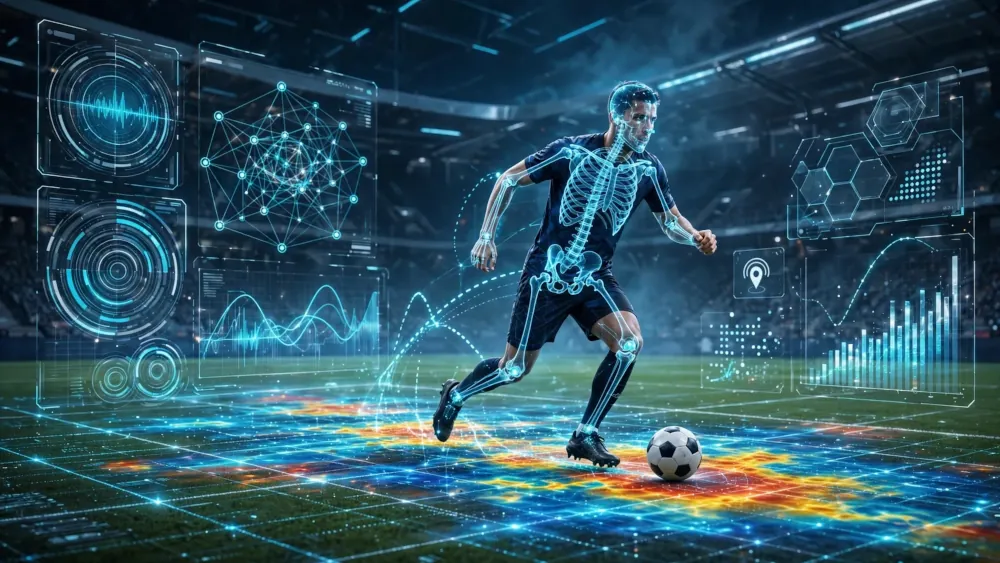
AI is increasingly used to analyse football players by processing large volumes of match, tracking and performance data that would be difficult to evaluate manually at the same scale. Rather than replacing football analysis, AI can help identify patterns in player behaviour, compare performance profiles, assess tactical roles and support scouting and player development.
The data available for player analysis can include match events such as passes, shots, carries and defensive actions, as well as positional and physical information from player tracking systems. Machine learning models can then be used to classify players, identify patterns, estimate performance and support specific analytical questions.
This makes AI relevant across several areas of football, from performance analysis and opposition preparation to scouting, recruitment and talent identification.
What Does AI Analyse When Evaluating a Football Player?
AI does not analyse a player from a single statistic. Player evaluation can involve multiple types of information that describe what a player does, where they do it, how often they do it and the context in which those actions occur.
The most useful inputs generally fall into several broad groups.
| Data type | Examples | What it can help assess |
|---|---|---|
| Event data | Passes, shots, carries, tackles, interceptions | Technical and tactical actions |
| Tracking data | Position, speed, distance, acceleration | Movement and physical behaviour |
| Spatial data | Player locations, distances, occupied spaces | Positioning and space management |
| Physical data | Running intensity, high-speed running, workload | Physical performance |
| Player profile data | Age, position, minutes, competition level | Context for comparison |
| Historical data | Previous performances and development | Trends and progression |
Event data describes discrete actions during matches, while tracking data can provide a continuous view of player movement and spatial relationships. These different data sources allow analysts to examine both individual actions and the circumstances in which those actions occur.
The important point is that AI can combine multiple variables rather than treating one metric as a complete representation of player quality.
For a broader introduction to the relationship between data and football analysis, see our guide to What Is Football Analytics?.
How AI Processes Football Player Data
A typical AI-based player analysis workflow begins with data collection and preparation.
Raw information usually needs to be cleaned, standardised and structured before a model can use it. This can include removing duplicate records, dealing with missing values, adjusting statistics for playing time and ensuring that variables are measured consistently.
The next stage depends on the analytical objective.
A club might want to identify players with a particular performance profile. An analyst might want to compare how two midfielders contribute in possession. A recruitment department might want to identify players whose statistical profiles resemble an existing player.
Different questions require different modelling approaches.
Statistical profiling
One relatively straightforward application is to construct a statistical profile from multiple player metrics.
For example, a midfielder could be evaluated using variables related to:
- Progressive passing.
- Ball retention.
- Carries.
- Chance creation.
- Defensive actions.
- Pressing activity.
- Possession involvement.
The purpose is not necessarily to produce one definitive player score. Instead, the profile can provide a structured way to compare players across relevant dimensions.
Classification
Machine learning can also be used to classify players into groups or roles.
A model might use technical, tactical and physical variables to distinguish between different player profiles. The resulting groups can help analysts identify players who share similar characteristics even when they play for different clubs or in different competitions.
Classification is particularly useful when the question is about player type rather than simply ranking players by one statistic.
Clustering and similarity analysis
Unsupervised learning methods such as clustering can group players according to similarities in their data.
For example, a recruitment analyst could create a dataset containing hundreds of midfielders and examine how their statistical profiles naturally separate into different groups.
This can reveal that players listed under the same broad position do not necessarily perform the same role.
Two midfielders may both be classified as central midfielders, for example, while one contributes primarily through progression and ball carrying and another provides defensive coverage and circulation.
AI-based profiling can therefore help move analysis beyond position labels towards more detailed descriptions of playing behaviour.
How AI Analyses Player Performance During Matches
AI can also be applied directly to match footage and tracking data.
Computer vision systems can identify players and estimate their positions from video, while tracking systems can provide positional information throughout a match. These data can then be analysed to study movement, positioning and interactions between players.
Tracking data is particularly valuable because football performance is strongly influenced by space and time.
A player's contribution cannot always be understood from the event recorded at the end of an action. A successful pass, for example, does not by itself describe the player's positioning before receiving the ball, the movement of teammates, the pressure applied by opponents or the space created by the action.
AI and machine learning can help analyse these spatiotemporal relationships.
This can support analysis of questions such as:
- How consistently does a player occupy useful spaces?
- How does a player react when possession changes?
- How frequently does a player move into space behind the defensive line?
- How does a defender adjust their position relative to opponents?
- How does a player's movement change across different phases of play?
These questions are difficult to answer using conventional event statistics alone.
For a wider explanation of how AI is applied to football analysis, see How AI Is Used in Football Analytics.
AI and Player Role Analysis
One of the useful applications of AI is analysing what a player actually does rather than relying only on their listed position.
Traditional positional labels can be broad. A full-back, for example, may operate primarily as a defensive player, provide width high up the pitch, move into midfield during possession or contribute differently depending on the team's tactical structure.
AI models can use combinations of event and positional variables to identify recurring patterns in these behaviours.
The same principle applies across the pitch.
A forward can be analysed according to factors such as:
- Shot locations and shot volume.
- Movement into the penalty area.
- Link-up involvement.
- Ball carrying.
- Pressing actions.
- Runs behind the defensive line.
- Chance creation.
A central midfielder can be evaluated using different combinations of:
- Passing volume and direction.
- Progressive actions.
- Ball recoveries.
- Defensive positioning.
- Carries.
- Pressure resistance.
- Involvement in possession sequences.
The result is a more detailed player profile that can be connected to tactical requirements.
This type of multidimensional profiling can help distinguish between players who share the same nominal position but perform different functions within their teams.
AI in Football Scouting and Recruitment
Player analysis becomes particularly valuable when it is connected to scouting and recruitment.
A recruitment department may start with a tactical or positional requirement rather than a specific player. For example, a club could be looking for a midfielder who can progress possession, contribute defensively and operate effectively within a particular playing model.
AI can help search large player datasets for profiles that match these requirements.
Instead of manually reviewing every available player, analysts can use data-driven filters and similarity models to narrow the candidate pool.
This does not mean that the model determines who should be signed. Recruitment decisions still require contextual assessment.
A player's statistics may be influenced by:
- Team style.
- League strength.
- Teammate quality.
- Playing time.
- Tactical responsibilities.
- Match state.
- Opposition.
- Position and role.
A player producing strong numbers in one environment may not reproduce exactly the same output in another.
This is why AI-based recruitment should generally be treated as a decision-support process rather than an automated transfer recommendation.
The relationship between data analysis, scouting and recruitment is explored further through AICUP.tools' Football Analysis, Data & Scouting and Scouting & Recruitment resources.
AI for Talent Identification and Player Development
AI can also be used to study player development, particularly when historical data is available.
For young players, analysts may be interested in more than current performance. They may want to understand how a player's technical, physical and tactical characteristics are changing over time.
Machine learning models can combine multiple variables to identify patterns associated with different development profiles.
Research into AI-based football talent identification has examined applications involving technical, physical, tactical, psychological and career-related variables. However, the available research also highlights important limitations, including differences in datasets, validation methods and sample representativeness.
This distinction is important.
Predicting future development is considerably more difficult than describing current performance. A model trained on historical data may identify patterns associated with players who progressed in a particular dataset, but that does not mean it can reliably determine the future level of every individual player.
For this reason, AI can support talent identification and player development without becoming a substitute for long-term observation and professional assessment.
The broader relationship between analysis and development is also relevant to Player Development & Assessment.
AI and Physical Performance Analysis
Player analysis is not limited to technical and tactical actions.
Tracking and wearable technologies can provide information about movement and physical workload, including distance covered, speed and acceleration. Player tracking data can be used to examine physical demands during training and matches, including differences between playing positions.
AI can help analyse these large datasets by identifying patterns across sessions, matches and players.
For example, an analyst might examine whether a player's physical output changes according to:
- Match intensity.
- Playing position.
- Training load.
- Minutes played.
- Fixture schedule.
- Tactical role.
Machine learning can also be used to structure and interpret complex tracking datasets. However, physical metrics still need to be interpreted in context. More distance or higher intensity is not automatically equivalent to better performance.
Physical output should therefore be considered alongside tactical role, match context and the demands of the player's position.
AI Can Combine Performance Metrics With Tactical Context
One of the central challenges in football analysis is that individual actions occur within a team environment.
A pass, tackle or run can have different meanings depending on the situation.
AI-based approaches can attempt to incorporate this context by analysing combinations of player positions, events, movement and surrounding actions.
For example, a model studying possession might consider not only whether a player completed a pass, but also where the player received the ball, the available passing options, the positions of opponents and teammates, and the subsequent development of the possession sequence.
Research into machine learning and space-control analysis has demonstrated how tracking and event data can be combined to study attacking and defensive space in football.
This type of analysis moves player evaluation closer to the tactical reality of football, where value often depends on relationships between players rather than isolated actions.
What Are the Benefits of Using AI to Analyse Football Players?
AI can provide several practical advantages when used appropriately.
Processing large datasets
A human analyst cannot manually inspect every variable for every player across hundreds of matches. AI can process much larger datasets and identify patterns that warrant further investigation.
Consistent comparisons
A structured model can apply the same analytical framework across a large group of players, which can make initial comparisons more systematic.
Identifying less obvious patterns
Machine learning can detect relationships between variables that may not be immediately visible when analysing individual statistics.
Supporting player profiling
AI can help create detailed profiles based on technical, tactical and physical characteristics rather than relying solely on position or headline statistics.
Supporting scouting workflows
Large player databases can be filtered according to defined requirements, helping recruitment teams focus their attention on relevant candidates.
These benefits are most useful when AI is integrated into an existing analytical workflow rather than treated as an independent decision-maker.
What Are the Limitations of AI Player Analysis?
AI does not remove the fundamental limitations of football data.
One problem is data quality. Tracking and event datasets can differ in how actions are defined, collected and processed. Commercial tracking data can also be difficult to access consistently across competitions.
Another issue is context.
A statistical model may identify that two players have similar outputs while overlooking differences in tactical instructions, opposition, teammates or league environment.
Model validation is another important consideration. Research on AI-based football talent identification has identified concerns including limited external validation, selective samples, differences in feature construction and difficulties in generalising findings across populations.
There is also a distinction between prediction and explanation.
A model may produce a useful prediction without making it obvious why the prediction was generated. For football staff, interpretability can matter because analysts need to explain findings to coaches, scouts and recruitment decision-makers.
Finally, football remains a context-dependent sport. Data can inform an assessment, but it does not capture every quality that matters to a player's contribution.
AI Player Analysis Still Requires Human Judgement
The most useful role for AI is generally to support football professionals rather than remove them from the analytical process.
An analyst can use AI to identify an unusual performance pattern, a scout can use a model to narrow a recruitment shortlist, and a coach can use analytical information to investigate a tactical problem.
The professional still needs to interpret the result.
This human layer matters because football decisions involve factors that may be difficult to represent fully in structured data, including tactical instructions, team context, adaptability and the specific requirements of a playing model.
AI can therefore make player analysis more scalable and systematic, but the quality of the final decision still depends on the quality of the data, modelling approach and football interpretation surrounding it.
The Role of AI in Modern Player Analysis
AI is expanding the ways football players can be analysed by making it possible to combine large amounts of event, tracking, physical and historical data.
Its applications range from statistical profiling and role classification to movement analysis, scouting, recruitment and talent identification. Machine learning can reveal patterns across players and matches that would be difficult to identify manually, particularly when large spatiotemporal datasets are involved.
At the same time, AI player analysis has clear limitations. Data quality, tactical context, model validation and differences between competitions can all affect the reliability of an analytical result.
The most useful approach is therefore not to treat AI as a replacement for football expertise. It is better understood as an analytical layer that can help football professionals ask better questions, process more information and investigate player performance more systematically.
For the broader context, see How AI Is Used in Football and How AI Helps Analyse Football Matches.
Related AI Tools

Hudl Wyscout
Hudl Wyscout is a professional football video analysis and scouting platform that provides clubs, scouts, coaches, agents, and analysts with a massive football video library, player data, performance analytics, and scouting tools.


