
What Is Football Analytics? A Guide to Football Data Analysis

Football analytics is the use of data, statistical methods and analytical techniques to understand football performance and support decision-making. It can be applied to matches, players, teams, tactics, recruitment, training and competition.
At its simplest, football analytics turns football events and observations into structured information that can be compared, interpreted and used to answer specific questions. Those questions might include how effectively a team creates chances, which areas of the pitch a player influences, how an opponent progresses the ball, or whether a recruitment target fits a particular playing style.
Football analytics is therefore broader than a collection of statistics. It combines data with football context and human interpretation. This distinction is important because a number alone rarely explains why something happened on the pitch.
The field overlaps with football analysis, data and scouting, performance analysis, scouting and recruitment, but these areas are not interchangeable. Analytics provides quantitative evidence that can complement video analysis, coaching expertise and scouting judgement.
What Does Football Analytics Mean?
Football analytics refers to the systematic collection, processing and interpretation of football-related data to identify patterns, evaluate performance and support decisions.
The data may describe individual actions such as passes, shots, tackles and carries, or more complex information such as player locations, team shape, possession sequences and physical outputs. Analytical methods can then be used to describe what happened, compare performances, identify patterns or estimate likely outcomes.
A useful way to think about the process is:
Football activity → data → analysis → interpretation → decision
For example, a coaching staff may want to understand why a team is struggling to progress the ball against a high press. Event data might show where turnovers occur, while tracking or video analysis can provide information about player positioning, available passing options and opposition pressure. The analytical task is not simply to report the number of turnovers, but to help explain the underlying performance problem.
This is why football analytics should not be confused with simply collecting statistics. The value of an analytical process depends on whether the information helps answer a meaningful football question.
How Does Football Analytics Work?
A typical football analytics workflow contains several connected stages.
1. Collecting football data
The first stage is gathering relevant information.
Football data can come from several sources:
- Match event data
- Player and team statistics
- Tracking data
- Video and computer-vision systems
- GPS and other location-based monitoring systems
- Training and physical-performance data
- Recruitment and player databases
- Historical match records
Event data records actions that occur during a match, such as passes, shots, fouls, interceptions and substitutions. Tracking data can provide much more detailed information about player and ball locations over time.
Different data sources answer different questions. A dataset containing shots can help analyse chance creation, while positional data can provide information about spacing, movement and team organisation.
The quality and definition of the underlying data also matter. Different providers can use different collection methods, event definitions and levels of detail, so analysts need to understand what a dataset actually represents before drawing conclusions from it.
2. Cleaning and organising the data
Raw football data is rarely ready for immediate analysis.
Analysts may need to check for missing observations, inconsistent definitions, duplicated events or differences in how competitions and providers record actions. Data may also need to be normalised so that performances can be compared appropriately.
For example, comparing a player's total number of defensive actions may be misleading if one player has played substantially more minutes than another. Analysts can therefore use rates or per-90-minute measures where appropriate.
The objective is not simply to produce more numbers. It is to create a dataset that is sufficiently consistent and relevant for the question being investigated.
3. Selecting relevant metrics
The next stage is deciding which measurements are useful.
A football analyst might examine:
- Goals and assists
- Shots and shots on target
- Expected goals (xG)
- Expected assists (xA)
- Progressive passes and carries
- Possession and ball retention
- Pressing and defensive actions
- Passing and chance-creation patterns
- Field position and territorial control
- Player workload and physical outputs
- Team and player trends over time
The appropriate metric depends on the question.
For example, goals alone may provide limited information when evaluating chance creation because finishing outcomes are influenced by relatively small samples and the quality of opportunities available. Expected goals, commonly abbreviated as xG, attempts to estimate the probability that a shot will result in a goal based on characteristics of the chance and comparable historical shots.
A metric should therefore be selected because it helps answer a football question, rather than because it is sophisticated or popular.
What Are the Main Types of Football Analytics?
Football analytics covers several overlapping areas.
Match analytics
Match analytics examines what happens during competitive fixtures.
Analysts may study:
- Chance creation
- Shot quality
- Passing patterns
- Possession sequences
- Ball progression
- Pressing
- Defensive actions
- Set pieces
- Transitions
- Territory and field position
- Team performance trends
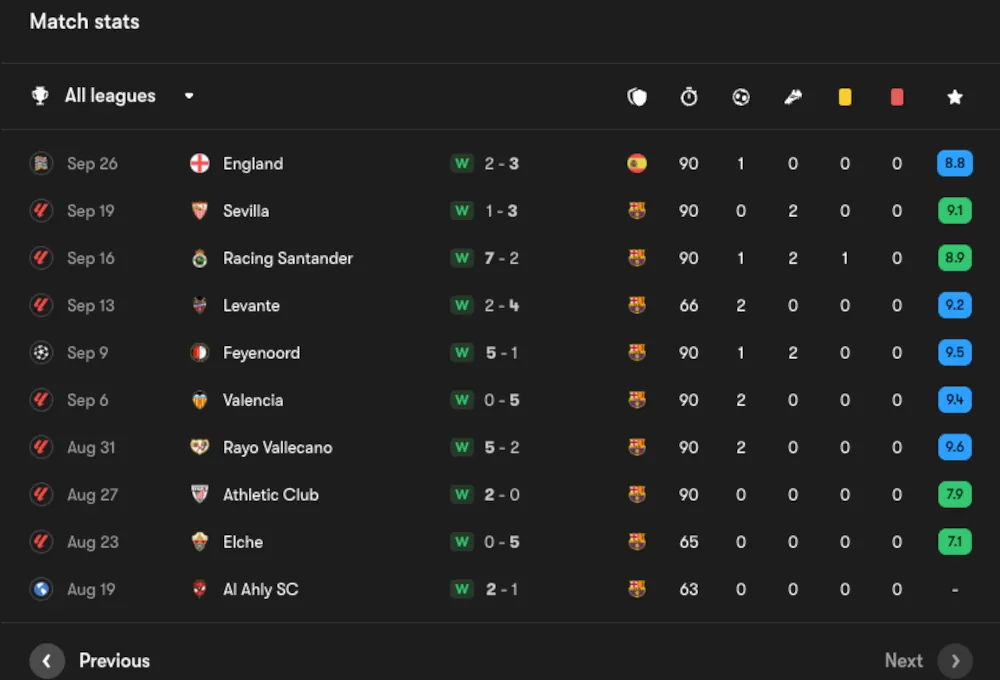
The purpose can range from reviewing a completed match to preparing for an upcoming opponent.
A post-match analysis might investigate why a team conceded opportunities, while opposition analysis could focus on how an upcoming opponent builds attacks or responds after losing possession.
Player analytics
Player analytics evaluates individual performance using statistical and contextual information.
The relevant metrics depend heavily on position and role. A centre-back, deep midfielder, winger and striker should not necessarily be evaluated using the same measures.
For example, a striker might be assessed through shooting volume, chance quality, movement and involvement in attacking sequences. A midfielder may require analysis of progression, ball retention, passing and defensive contribution. A defender's evaluation could include defensive actions, positioning, progression and involvement in build-up play.
This illustrates an important principle in football analytics: context matters.
A high number in one metric does not automatically indicate superior performance. The player's role, team structure, tactical instructions, competition level and match context all influence how a statistic should be interpreted.
Tactical analytics
Tactical analytics examines relationships between players, teams and space.
It can involve questions such as:
- How does a team create numerical advantages?
- Where does a team progress the ball?
- How effectively does it defend space?
- How does its pressing structure change during a match?
- Which passing options are available in different situations?
- How does the team behave during transitions?
Tracking data can be particularly useful here because it captures information about player locations and movement rather than only recording the final outcome of an event.
Modern research also uses computational and machine-learning approaches to examine player interactions, collective movement and tactical behaviour. These methods can operate at individual, group and team levels, but their usefulness still depends on how the resulting information is interpreted within football context.
Recruitment analytics
Recruitment analytics applies data to player identification and evaluation.
A recruitment department may use data to screen large numbers of players and identify profiles that meet specific requirements. This can make an initial search more systematic, particularly when a club needs to examine players across multiple competitions or markets.
For example, a club looking for a particular type of midfielder could define a statistical profile based on its tactical requirements and then identify players whose performances match relevant characteristics.
Analytics does not remove the need for scouting. Statistical evidence can identify potentially relevant players, while video analysis, live scouting, background information and football expertise can provide additional context.
This is one reason football analytics is increasingly connected with scouting and recruitment.
Performance analytics
Performance analytics focuses on understanding and improving player and team performance.
It can incorporate technical, tactical and physical information. UEFA describes performance analysis in elite football in terms of understanding the technical, tactical and physical requirements involved in developing and improving performance.
This area can overlap considerably with coaching and sports science. Depending on the question, analysts may examine match actions, tactical behaviours, training outputs, workload or other performance indicators.
The broader field of football performance and tracking includes technologies and methods used to capture and interpret this type of information.
Which Football Analytics Metrics Matter?
There is no universal list of the most important football metrics.
The appropriate metrics depend on the decision being made.
Expected goals
Expected goals, or xG, estimates the likelihood that a shot will result in a goal. It is commonly expressed on a scale from 0 to 1, with higher values representing higher-quality scoring opportunities.
For example, a hypothetical shot with an xG value of 0.20 represents a model-estimated scoring probability of 20%. It does not mean that the player is expected to score exactly one goal from five attempts in every practical situation.
xG is useful because it provides information about chance quality rather than simply counting goals. However, different xG models can use different inputs and methodologies, so figures from different providers are not necessarily identical or directly interchangeable.
Expected assists
Expected assists, or xA, estimates the likelihood that a pass leading to a shot will result in a goal, according to the methodology of the model being used.
It can provide additional information about chance creation because an assist depends partly on what happens after the pass. xA attempts to evaluate the quality of the opportunity created by the pass rather than only recording whether an assist was officially awarded.
Progressive actions
Progressive passing and carrying metrics attempt to capture actions that move the ball meaningfully towards an attacking area.
These measures can help analysts examine ball progression, but definitions vary between providers. Analysts should therefore understand how a metric is defined before comparing results from different datasets.
Possession and passing metrics
Possession percentage, pass completion and passing volume are among the most familiar football statistics.
They can be useful descriptive measures, but they require context. A high possession percentage does not automatically indicate territorial dominance or attacking effectiveness, just as high pass completion does not necessarily mean that a team progressed the ball effectively.
The tactical purpose and location of actions can matter as much as their raw totals.
Tracking and physical metrics
Tracking systems can provide information about player movement and team organisation. Depending on the technology and methodology, this may include variables related to distance covered, speed, acceleration, positioning and collective movement.
These measurements are particularly relevant to performance and physical analysis, but they also require careful interpretation. Physical output can be affected by position, tactical role, match state, opposition and other contextual factors.
Football Analytics vs Performance Analysis
Football analytics and performance analysis overlap, but they are not exactly the same.
Football analytics generally places greater emphasis on statistical, computational, data-driven and model-based approaches to understanding football.
Performance analysis is a broader applied process that can combine numerical data, video, observational analysis and communication with coaches and players.
A performance analyst might use video to show how a team failed to protect a particular space. An analytics workflow might then use event or tracking data to quantify how frequently the problem occurred or under which circumstances it appeared.
In practice, the two disciplines can work together.
The distinction is important because football cannot be reduced entirely to numerical measurements. Some tactical behaviours are difficult to capture through a single metric, while some statistical patterns require video or coaching knowledge to understand properly.
Research into the application of data science in professional football has highlighted this challenge: analytically meaningful information does not automatically translate into improved coaching outcomes. The way information is communicated and incorporated into training and decision-making matters as well.
Football Analytics in Scouting and Recruitment
One of the most visible applications of football analytics is player recruitment.
A recruitment process can use analytics at several stages:
- Define the player profile based on the club's tactical and squad requirements.
- Screen potential candidates using relevant statistical criteria.
- Compare players while accounting for position, minutes, competition and role.
- Review video and contextual information for shortlisted players.
- Conduct further scouting and due diligence before making a recruitment decision.
Analytics can be particularly useful for narrowing a large candidate pool.
For example, instead of manually reviewing every midfielder in a large database, a recruitment team could establish a profile around progression, ball retention, defensive contribution and other role-specific characteristics. The resulting shortlist can then be assessed through video and traditional scouting methods.
This is a more realistic description of analytics in recruitment than treating a model as a replacement for scouts.
The broader football analysis, data and scouting landscape combines statistical information with other forms of football intelligence.
How Football Analytics Supports Coaches
Coaches can use analytics to structure questions around both their own team and upcoming opponents.
A post-match review might examine where possession was lost, how chances were created, or whether a particular tactical behaviour occurred consistently.
Opposition analysis can examine patterns in build-up play, pressing, transitions, set pieces or attacking development.
The most useful analytical output is usually not the largest report. It is information that helps the coaching staff answer a specific question.
For example:
Where does the opponent create progression opportunities when our first pressing line is bypassed?
That question can potentially be investigated through event data, positional information and video. The final output might then be a small number of clips, visualisations or metrics that help the coaching staff prepare for the relevant situation.
This decision-oriented approach is important because analytics is ultimately part of a football workflow. A metric that cannot be interpreted or acted upon may have limited practical value, regardless of how sophisticated the underlying model is.
What Role Does Artificial Intelligence Play in Football Analytics?
Artificial intelligence and machine learning can be used within football analytics, but football analytics is not synonymous with AI.
Traditional statistical analysis can answer many football questions without artificial intelligence. AI becomes relevant when computational methods are used for tasks such as pattern recognition, classification, prediction, computer vision or the analysis of large and complex datasets.
For example, computer-vision systems can be used to derive information from video, while machine-learning approaches can be applied to player tracking data or other structured datasets.
AI-based tactical research has expanded considerably, including work examining collective movement, player interactions, formations and tactical behaviours. However, the presence of AI does not automatically make an analytical output more accurate or more useful.
This distinction connects football analytics with the wider subject of how AI is used in football analytics. It also helps separate the analytical discipline itself from one particular family of computational techniques.
What Are the Limitations of Football Analytics?
Football analytics can provide valuable evidence, but it has important limitations.
Data quality and definitions
Different providers may collect and define events differently. This can make direct comparisons difficult.
A statistic is only meaningful when its definition and collection method are understood.
Sample size
Football contains substantial randomness and relatively few scoring events compared with many other sports.
A short run of matches may therefore produce misleading conclusions. Longer samples can provide more stable information, although even large samples need contextual interpretation.
Tactical context
A statistic can look very different depending on the tactical role of a player or team.
For example, a midfielder instructed to prioritise ball security may produce a different statistical profile from one encouraged to attempt progressive passes frequently. Neither profile can be evaluated properly without understanding the role.
Model uncertainty
Predictive and probabilistic models produce estimates rather than guarantees.
An xG value, player projection or match prediction represents the output of a particular model and dataset. It should not be interpreted as a statement about what must happen.
Data does not explain everything
Some elements of football are difficult to capture quantitatively.
Communication, leadership, tactical understanding, decision-making under pressure and interpersonal factors may not be represented adequately by a single metric. This does not make them unimportant; it means they require different forms of evaluation.
Recent research has also highlighted an analytics-to-practice gap in sport: increasing quantities of tracking, wearable, video and analytical data do not automatically result in better coaching decisions. Actionability, context, integration and communication remain important parts of the process.
Why Is Football Analytics Important?
Football analytics matters because it can make complex football information easier to structure, compare and investigate.
For clubs, potential applications include:
- Supporting match and opposition analysis.
- Evaluating player and team performance.
- Identifying recruitment targets.
- Monitoring tactical trends.
- Supporting player development.
- Analysing physical and workload information.
- Testing hypotheses about performance.
- Providing evidence for football decisions.
For analysts, analytics can create a more systematic way to investigate questions that might otherwise rely heavily on subjective observation.
For coaches and sporting directors, the value lies less in having more statistics and more in having relevant information at the right time.
That distinction is central to modern football analytics: better decisions do not necessarily come from more data. They come from using appropriate data in the right context.
How to Start Learning Football Analytics
Someone new to football analytics does not need to begin with complex machine-learning models.
A practical learning path can start with fundamental football concepts and progressively introduce more advanced analytical methods.
Start with football data
Learn how event data, player statistics and match data are structured. Understand basic concepts such as minutes played, rates, possession, shots and chance creation.
Learn the key metrics
Become familiar with concepts such as xG, xA, progressive actions and possession-related measures. More importantly, learn what each metric measures and what it does not measure.
Add tactical context
Statistics become more meaningful when connected to formations, roles, pressing structures, transitions and playing styles.
Learn to question the data
Ask:
- How was this metric defined?
- What is the sample size?
- Is the comparison appropriate?
- Does the player's role affect the number?
- What tactical context explains the result?
- What decision could this information support?
Combine data with video
One of the most useful habits for football analysts is to move between quantitative information and what actually happened on the pitch.
A statistical pattern can identify something worth investigating. Video can then help explain the football context behind that pattern.
The Future of Football Analytics
Football analytics is likely to remain closely connected to improvements in data collection, tracking, video analysis and computational modelling.
However, the direction of development is not simply about collecting increasingly large datasets.
The more important challenge is connecting information to football decisions.
Better analytical workflows can combine event data, tracking information, video, physical measurements and contextual information while presenting the results in a form that coaches, scouts and sporting staff can actually use.
Artificial intelligence may contribute to this process by helping identify patterns or process information at scale, but the fundamental analytical task remains the same: asking a meaningful football question, selecting appropriate evidence, interpreting it carefully and communicating the result clearly.
Frequently Asked Questions
What is football analytics?
Football analytics is the use of football data, statistics and analytical methods to understand player and team performance and support football decision-making.
What data is used in football analytics?
Common sources include event data, player statistics, tracking data, video-derived information, physical-performance data and historical match records.
Is football analytics the same as AI?
No. AI is one group of computational techniques that can be used within football analytics. Football analytics also includes conventional statistics, data analysis and other quantitative methods.
What is xG in football analytics?
Expected goals (xG) is a model-based measure that estimates the probability of a shot resulting in a goal. It is used to evaluate chance quality rather than simply counting goals.
Do football clubs use analytics for scouting?
Analytics can support scouting and recruitment by helping clubs screen players, compare profiles and identify candidates for further evaluation. It complements rather than automatically replaces scouting and football expertise.
Can football analytics predict match results?
Analytical models can estimate probabilities or expected outcomes, but football matches contain uncertainty and models cannot guarantee a particular result.
Conclusion
Football analytics is the structured use of data and analytical methods to understand football performance and support better-informed decisions.
Its applications range from match and tactical analysis to player evaluation, recruitment, performance monitoring and opposition analysis. Metrics such as xG can provide useful evidence, while tracking and video-derived data can add information about movement, space and tactical behaviour.
The most important point is that football analytics is not simply about producing statistics. Data becomes useful when it is connected to a clear football question and interpreted within the appropriate tactical, technical and competitive context.
For that reason, effective football analytics sits between data and football expertise. Analysts provide structured evidence; coaches, scouts and sporting staff contribute context and judgement. The combination can provide a stronger basis for understanding performance than either data or observation in isolation.